

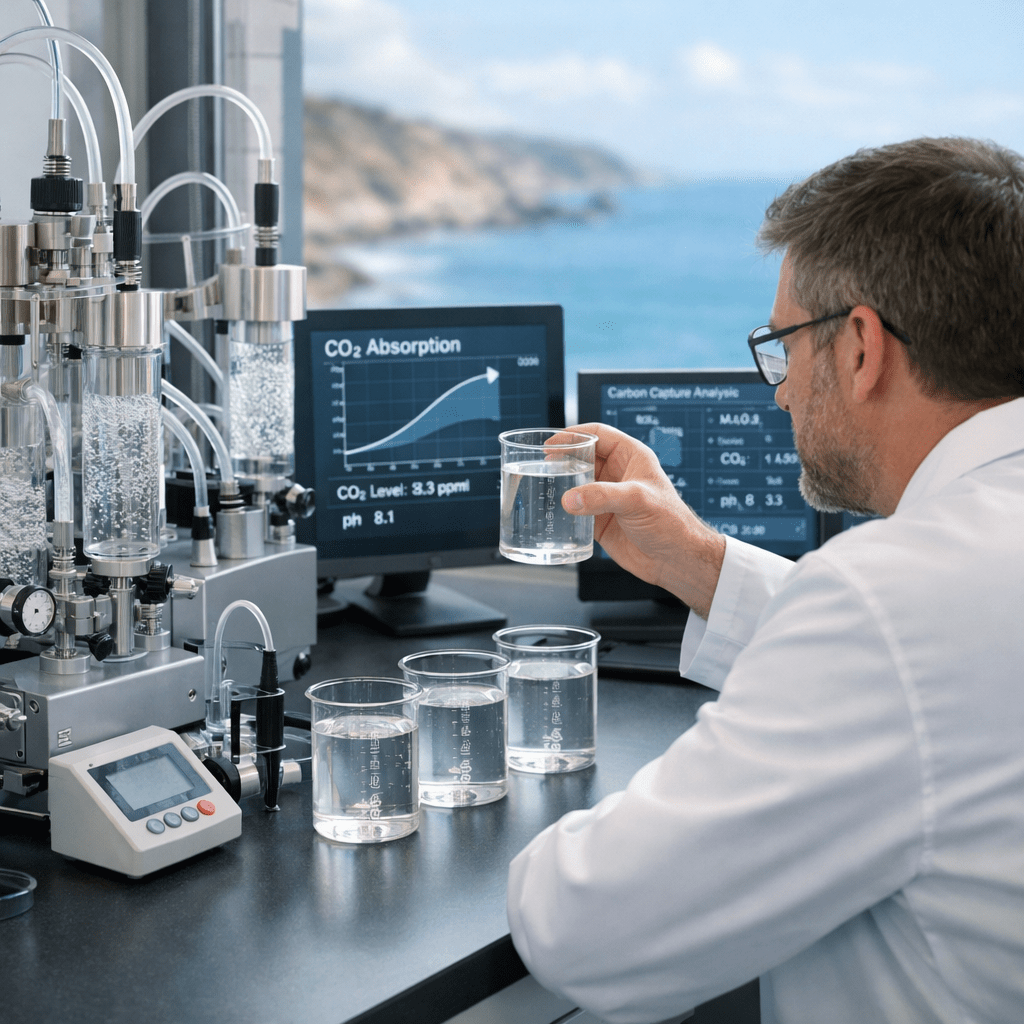
Wondering how to apply for the ESPCI PhD on seawater treatment for CO2 removal? Discover eligibility, deadlines, professors, and a step-by-step guide to secure your spot in this cutting-edge project. Imagine harnessing the ocean’s vast power to combat climate change, one PhD project at a time. The ESPCI PhD in seawater CO2 capture via electrochemical microelectrode arrays (STREAM) offers you this groundbreaking chance, starting in October 2026. Therefore, dive into this 36-month adventure at ESPCI Paris, where you’ll pioneer membrane-free CO2 extraction from seawater, turning environmental challenges into innovative solutions. Moreover, with world-class supervision and real-world impact, this opportunity positions you at the forefront of sustainable energy research.
Overview of ESPCI PhD Seawater CO2 Capture
The ESPCI PhD project, titled “Seawater Treatment for CO2 Removal via Electrochemical Microelectrode Arrays” (STREAM), represents a cutting-edge 36-month doctoral opportunity starting October 1, 2026. Specifically, it innovates direct CO2 extraction from oceans using microelectrode arrays (MEAs), which generate localized pH swings to shift the HCO3-/CO2 equilibrium without chemicals or membranes. Moreover, hosted jointly at ESPCI Paris’s Institute of Porous Materials (IMAP) and Institute of Chemistry, Biology Innovation (CBI), this research tackles climate change by leveraging seawater’s vast dissolved CO2 reserves—150 times higher than the atmosphere. Consequently, successful applicants will pioneer simplified reactors for CO2-to-CO conversion, advancing negative emissions technologies while gaining expertise in electrochemistry, catalyst design, and reactor engineering. For instance, the project’s schematic illustrates MEAs with micrometer-scale anode-cathode gaps driving oxygen evolution (OER), CO2 reduction (CO2RR), and hydrogen evolution (HER), ensuring bulk pH stability.
This initiative stands out because existing methods like membrane electrodialysis or chloride-mediated processes suffer from pH extremes, causing contamination and material degradation. Therefore, STREAM’s membrane-free design, paired with gas diffusion electrodes (GDEs) for selective CO/CO2 extraction, promises higher stability and efficiency. Additionally, it emphasizes non-precious catalysts (e.g., Ni-based with minimal Ir or AuAg), operando characterization via AFM, and techno-economic benchmarks against state-of-the-art systems. As a result, PhD candidates will contribute to real seawater testing, mapping optimal conditions like current density, flow rate, salinity, and temperature. In summary, this ESPCI PhD seawater CO2 capture opportunity equips researchers for impactful careers in sustainable energy.
Eligibility Breakdown for ESPCI PhD Seawater CO2 Capture
Prospective candidates must hold an excellent academic record, typically a Master’s degree in physical chemistry, electrochemistry, chemical/energy engineering, or materials chemistry. Furthermore, they need a rigorous and enthusiastic profile with strong interdisciplinary passion, spanning molecular mechanisms to full-scale device engineering. Specifically, a solid understanding of electrochemical kinetics, mass transport, electrode processes, and basic fluid dynamics is required, alongside hands-on experience in experimental electrochemistry.
Key soft skills include independence, collaboration, organizational skills, strong communication, and fluency in English, since the project involves international teamwork. Moreover, advantageous technical assets feature proficiency in CAD software like Autodesk Fusion 360 for reactor design and Python programming for data analysis or modeling. For example, previous experience with thin-film deposition techniques such as ALD or PECVD, electrodeposition, or operando methods like AFM imaging will significantly differentiate top applicants.
Academics:
Core Requirements – Master’s in electrochemistry/related fields; excellent grades. Desirable Extras – Publications in energy journals. Rationale – Builds foundational knowledge.
Technical Skills:
Core Requirements – Kinetics, mass transport, and lab electrochemistry. Desirable Extras – CAD (Fusion 360), Python, catalyst synthesis. Rationale – Enables reactor prototyping and analysis.
Personal Traits:
Core Requirements – Motivated, rigorous, collaborative; fluent English. Desirable Extras – Independent researcher mindset. Rationale – Supports 36-month PhD rigor.
Experience:
Core Requirements – Hands-on electrode testing. Desirable Extras – Seawater/CO2 projects, AFM operando. Rationale – Direct project relevance.
Non-EU applicants remain eligible provided they secure visa approval, and candidates from related fields like environmental engineering can qualify with compelling motivation. Therefore, this eligibility breakdown for ESPCI PhD seawater CO2 capture guarantees that selected researchers excel in a dynamic, high-impact multidisciplinary setting.
Application Deadline for ESPCI PhD Seawater CO2 Capture
While no fixed closing date appears in the proposition, applications should commence immediately, as the project launches on October 1, 2026, under Doctoral School ED397 timelines. Therefore, French PhD cycles often recruit 6-12 months prior, urging submissions by summer 2026 to secure funding and lab spots. Moreover, early applications allow supervisors to review amid competing propositions, especially for funded positions.
Funding follows ED397 salary standards (approx. €2,000-2,500 net/month), confirming financial security for selected candidates. For instance, contacting professors now facilitates pre-interviews, aligning with ESPCI’s rolling review process. Consequently, monitor email responses within 2-4 weeks; delays past mid-2026 risk missing the start. In essence, proactive timing maximizes chances for this ESPCI PhD seawater CO2 capture deadline flexibility. For more information, click HERE.
LinkedIn page: ESPCI Paris – PSL
Application Method for ESPCI PhD Seawater CO2 Capture
Direct email submission to supervisors Dr. Loïc Assaud ([email protected]) and Dr. Alexandr Oshchepkov ([email protected]) is the sole method—no formal ADUM portal required for this specific proposition. Specifically, attach a complete CV, tailored motivation letter (1-2 pages), and 2-3 recommendation letters in PDF format. Additionally, use a clear subject line like “PhD STREAM Application – [Your Full Name]” to ensure prompt review.
Hosted at Univ. PSL, ESPCI, ENS, CNRS (IMAP/CBI), applications emphasize fit for electrochemical innovation. For example, highlight how your skills address challenges like MEA stability in saline conditions. Post-submission, polite follow-ups after 2 weeks demonstrate enthusiasm. Thus, this streamlined method for ESPCI PhD seawater CO2 capture prioritizes quality over bureaucracy.
Details of the Professors
Dr. Loïc Assaud, based at IMAP (Univ. PSL, ESPCI, ENS, CNRS), leads with expertise in porous materials, electrochemistry, and advanced characterization for energy devices. Notably, his work on catalyst synthesis (ALD/PECVD/electrodeposition) and operando AFM aligns directly with STREAM’s microelectrode optimization. Contact him as the primary for applications, reflecting his pivotal role in reactor architecture.
Dr. Alexandr Oshchepkov, at CBI (Univ. PSL, ESPCI, CNRS), specializes in chemical-energy engineering, focusing on robust catalysts and seawater-compatible processes. Furthermore, his contributions to non-precious metal formulations (Ni-based) and mass transport engineering complement Assaud’s strengths, fostering synergistic supervision. Both professors’ interdisciplinary profiles—spanning mechanisms to prototypes—ensure comprehensive PhD guidance.
Their ESPCI LinkedIn presence underscores a vibrant research community, ideal for networking. Therefore, these details on professors for ESPCI PhD seawater CO2 capture highlight mentorship excellence.
Step-by-Step Application Guide for ESPCI PhD Seawater CO2 Capture
1: Deep Dive into Project. First, dissect the PDF’s context, state-of-the-art (e.g., electrodialysis limitations), and innovations like MEA-GDE integration for pH-confined CO2 release. Consequently, note references (Eisaman 2012, Digdaya 2020) to cite in your letter, showcasing diligence.
2: Tailor Motivation Letter. Next, write 1-2 pages detailing your electrochemistry journey, e.g., “In my Master’s, I optimized OER catalysts, mirroring STREAM’s eq. 1 needs.” Moreover, explain climate passion and interdisciplinary fit, using transition phrases for flow.
3: Secure Recommendations. Then, request 2-3 letters from supervisors familiar with your lab work, emphasizing skills like electrochemical testing or Python analysis. Provide them with the project PDF for context.
4: Polish CV. After that, quantify achievements: “Developed MEAs with 80% CO2 selectivity; modeled mass transport via COMSOL.” Include publications, skills matrix, and ESPCI alignment.
5: Submit and Follow Up. Finally, email both professors with all the docs; CC yourself. Follow up in 2 weeks: “Excited to discuss my fit for STREAM.” Prepare for interviews on technical challenges.
Additional tips: Customize for French norms (concise, formal); proofread thrice. This step-by-step guide for ESPCI PhD seawater CO2 capture boosts success rates significantly.
FAQ for ESPCI PhD Seawater CO2 Capture
What is the exact focus? Electrochemical microelectrode arrays for direct seawater CO2 extraction to CO, membrane-free, with stable pH.
Is funding confirmed? Yes, 36 months at ED397 salary rates (~€2,000+/month net).
Non-EU eligible? Absolutely; English suffices, visa support is typical for top candidates.
No direct electrochemistry experience? Related fields ok if motivated; emphasize transferables like materials synthesis.
Where based? ESPCI Paris (IMAP/CBI campuses), PSL University ecosystem.
Expected outputs? Optimized reactors, catalyst benchmarks, and publications on MEA performance/degradation.
Interview process? Likely technical discussion post-email; prepare OER/CO2RR mechanisms.
Can I start earlier? Fixed Oct 1, 2026; inquire about flexibility



Leave a Reply