

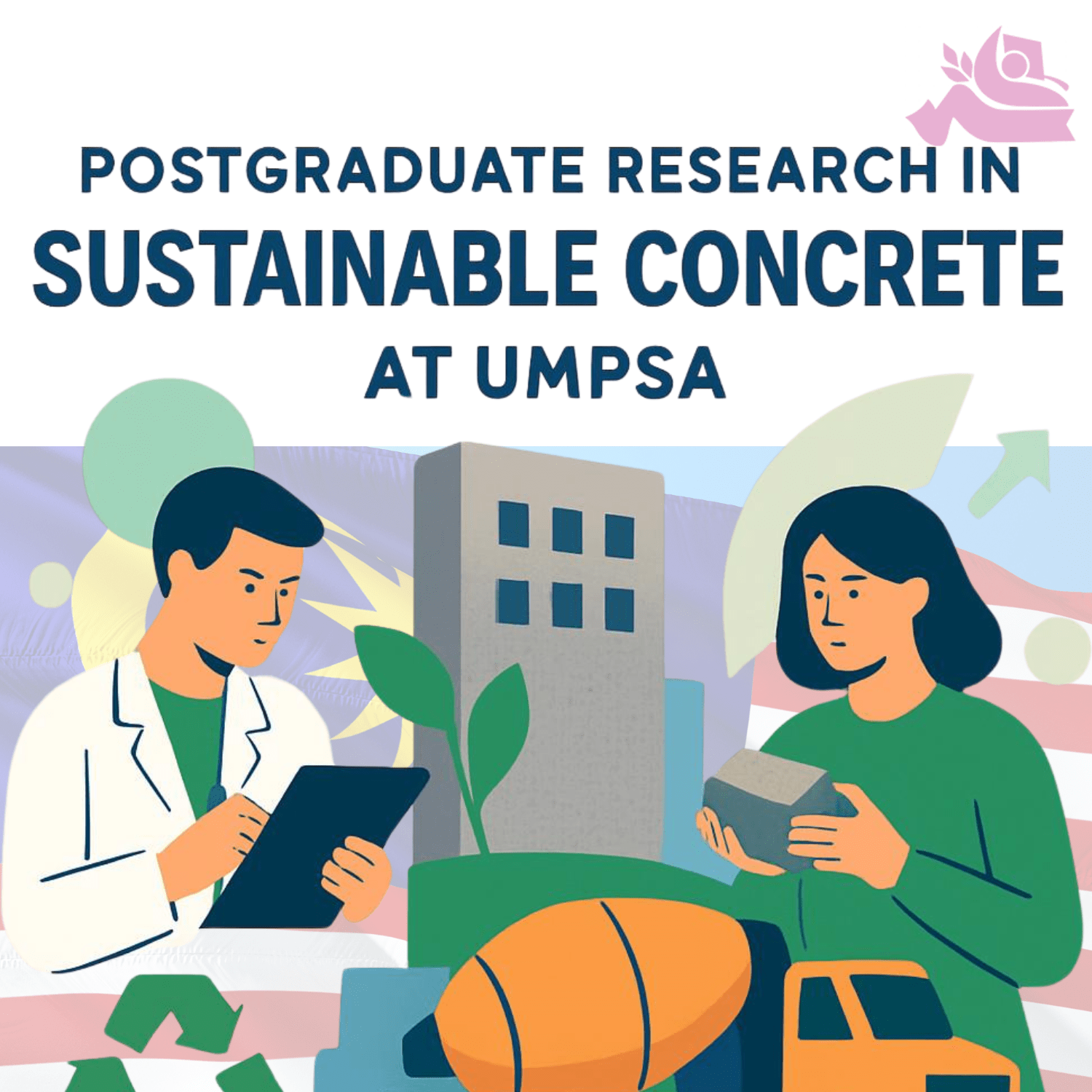
If your goal is to build on the principles of low-carbon development in construction and you wish to make a contribution towards greener and more resilient infrastructure, then pursuing a master’s or doctoral program in sustainable concrete could be your next logical move. There are several options available for interested students in both fields at UMPSA.
Sustainable concrete importance
The construction industry plays a big part in greenhouse gas production, where Portland cement and regular concrete are among the key causes. Engineers around the globe are developing new materials in efforts to lower the carbon footprint that is created from buildings and structures via the use of new materials.
The field of sustainable concrete involves studying how to make concrete with lower environmental impacts while still retaining its strength and durability. This area includes such things as industrial byproducts, alternative cementitious materials, new admixtures, and new testing methods used to understand the performance of concrete in actual service environments. With increasing urbanization and climate issues, this is a growing area of knowledge.
Concerning the Research Field
Some possible topics for graduate work in this research field include:
- Design of low-carbon concrete and cementitious composites
- Use of recycled or residual materials (such as industrial residuals, agri-waste) as partial replacement materials to substitute cement or aggregates
- Performance evaluation of environmentally sustainable concrete mixes in terms of durability, microstructure, and life-cycle assessment
- Characterization and mechanical testing of novel concrete mixes
Depending on the student’s qualifications and interests and ongoing research within the group, other topics might be considered.
Who can apply for sustainable concrete research?
The available projects would be suitable for individuals who are looking forward to expanding their knowledge in civil engineering and sustainable building materials. We encourage applications from those who:
- Possess (or are in the process of obtaining) a Bachelor’s degree in Civil Engineering, Structural Engineering, Materials Engineering, or any other relevant discipline
- Show great interest in concrete materials science, sustainable construction materials, and research work in general (either experimentally or analytically)
- Are ready to conduct experiments, analyze data, and write up academic papers
- Are proactive, eager to learn, and able to work as part of a team
Research experience, knowledge of concrete material tests, or numerical modeling and programming skills will be highly valued but not required. Finally, senior undergraduate students and practicing engineers with an interest in researching sustainable concrete materials are welcome to get in touch.
Level of study, place, and context
Postgraduate studies are conducted at Universiti Malaysia Pahang Al-Sultan Abdullah (UMPSA), Faculty of Civil Engineering Technology.
- Level of study: Master’s and Doctorate
- Subject area: Civil Engineering, Concrete Technology, Sustainable Construction Materials
- Place: Pahang, Malaysia
Context and resources: Postgraduate studies provide access to an academic context that is conducive to learning and is furnished with necessary lab facilities and equipment for testing concrete and construction materials. Collaboration opportunities with industries and research groups will depend on the nature of the project under study.
Collaboration with Prof. Dr. Khairunisa Muthusamy
The selected students will be under the mentorship of Prof. Dr. Khairunisa Muthusamy from the Faculty of Civil Engineering Technology, UMPSA. Her research interests include sustainable concrete and alternative construction materials that focus on improving performance and lowering environmental impacts.
Through her mentorship, one may expect the following:
- Guidance on conducting experiments or analyses
- Help in acquiring skills to write scholarly papers, both for conferences and journals
- Chances to contribute to current research networks associated with sustainable construction
Such a research environment is especially beneficial for students looking to build up their own research portfolio and embark upon a scientific or specialist engineering career path.
Expression of interest for sustainable concrete research
Potential applicants for the Master’s and PhD programs who would like to pursue research opportunities in these fields are encouraged to get in touch to discuss possible topics and qualifications.
Please send the following documents via email to:
- Updated CV
- Official transcript or recent grades
- Statement of research interests (1-2 pages)
at:
Prof. Dr. Khairunisa Muthusamy
Civil Engineering Technology Faculty
Universiti Malaysia Pahang Sultan Al-Abdullah (UMPSA), Malaysia, Pahang
Email: [email protected]
If you have any queries related to funding, commencement dates, or the topic of the research project
Spread the word about this sustainable concrete opportunity
If you know any final-year students studying civil engineering, recent graduates or young engineers, or any of your peers who are looking for opportunities in sustainable concrete and construction materials specialization, then I would request you to spread the word. This will help someone else reach the next level in their postgraduate studies.
Sustainable Crop Protection & Bio‑Based Materials: 8 Funded PhD
Questions that often come up:
1. Who can apply for the sustainable concrete postgraduate opportunities?
These opportunities are open to people who have earned a bachelor’s degree in civil engineering, structural engineering, materials engineering, or other closely related disciplines. Undergraduates who are finishing their studies and are in their final year can also apply, as well as professionals who want to specialize in sustainable concrete.
2. Do you need previous research experience in sustainable concrete?
Having research experience will help you, but it is not required. What matters most is motivation, good grades, and a genuine interest in sustainable concrete and construction materials. Guidance and training will be provided during the research process.
3. Are there funded positions or scholarships available?
It depends on whether the supervisor currently has funds from various grants and university programs. It would be best to communicate with Prof. Dr. Khairunisa Muthusamy personally to find out the latest information about financial support.
4. What documentation do I need to get in touch with the supervisor?
The application materials should include your resume, academic transcripts (or recent grades if you are still studying), and a statement of your research goals and motivation (1–2 pages). Including previous experience or publications is beneficial.
5. Can I suggest a research theme independently?
Yes, you can, but it should fit within the scope of sustainable concrete and construction materials. Possible topics will be discussed with the supervisor to assess their feasibility.
6. What is the usual duration of master’s and PhD programs?
Master’s by research program for the full-time students usually lasts for two years, and PhD program takes approximately three to four years full-time. The exact duration depends on the progress of the research and institutional rules.
7. Can I study as a part-timer while employed for the sustainable concrete research?
It might be possible to conduct part-time studies, depending on the universities’ policies and type of the research conducted. Students, who are interested in pursuing their studies part-time, should clearly specify it to the supervisor at the stage of the first contact.
8. What kind of research work will I be engaged in sustainable concrete?
Depending on the particular research project, it may involve experimental investigation (e.g. mix design, casting, testing mechanical properties and durability), material characterization, data analysis, as well as potentially modeling or life cycle assessment. Details will be specified depending on the research topic.
9. What kinds of jobs are open to me after completion of the degree in sustainable concrete?
The degree will allow graduates to take positions such as civil/structural engineers specializing in sustainable materials, R&D engineer in the industrial companies, consultancy related to infrastructures and constructions, and further research and teaching within academia.
10. How can I begin the process of applying for sustainable concrete?
Contacting Prof. Dr. Khairunisa Muthusamy via email and submitting your CV, academic transcript, and letter of interest in the particular research topic will constitute the initial step of the procedure. Based on the evaluation of your suitability for the position, you may be asked to proceed further.

Leave a Reply