

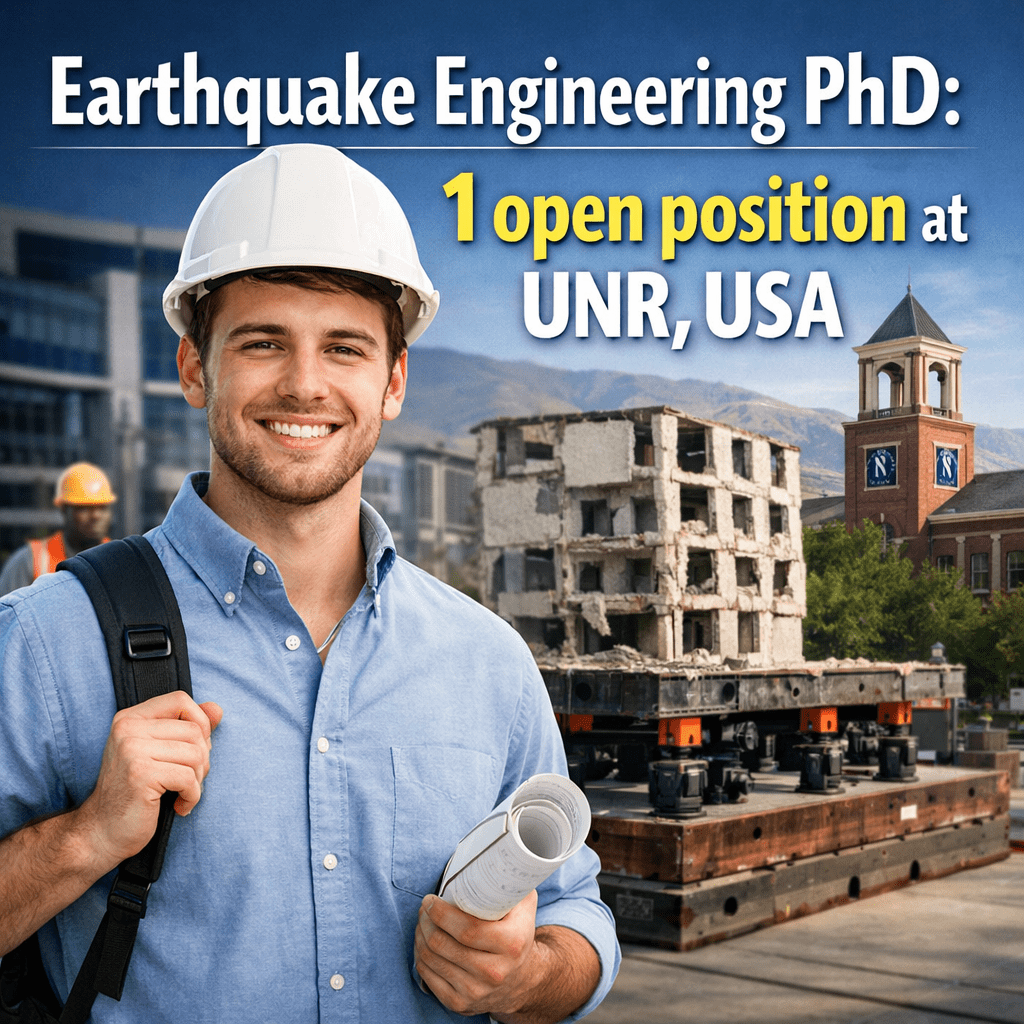
Join a UNR earthquake engineering PhD opportunity focused on probability, statistics, and uncertainty quantification, working on structural response under extreme ground motions in Professor Floriana Petrone’s research group at the University of Nevada, Reno. This blog post explains eligibility, deadlines (program-specific), how to apply, and how to contact the advisor directly.
In the sections that follow, you will find a detailed breakdown of eligibility criteria, an explanation of program-specific application timelines, a clear “Apply Here” guide, and a step-by-step walkthrough to help you prepare a compelling application. You will also find answers to frequently asked questions about this PhD opportunity, including how best to contact Professor Floriana Petrone and how to highlight your strengths in probability, statistics, and computational methods. If you are ready to turn your quantitative skills into tangible impact, keep reading—the next section will show you exactly how to position yourself as a strong candidate for this unique and highly competitive research opportunity.
Overview of PhD Opportunity at UNR, USA
If you want an earthquake engineering PhD that blends stochastic modeling with real structural dynamics, UNR’s earthquake and structural engineering research ecosystem is a strong fit. Professor Floriana Petrone’s group emphasizes advanced numerical modeling, uncertainty quantification, and risk-informed seismic design, which aligns with modern probabilistic earthquake engineering.
At UNR, earthquake and structural engineering research includes simulating earthquake effects and conducting lab-scale validation, supported by a dedicated structures program. The work commonly intersects with open-source simulation tools such as OpenSees, which is designed for earthquake engineering performance simulation of structural and geotechnical systems.
Eligibility breakdown
This PhD opening targets applicants who can operate comfortably in probability and statistics and apply those tools to seismic engineering problems. The profile also fits students who enjoy moving between theory (statistical learning, stochastic modeling) and engineering decisions (risk, performance, nonlinear dynamics).
Required background
-
PhD readiness in probability and statistics, because the work emphasizes uncertainty quantification for the applications.
-
Ability to connect statistical thinking to structural response modeling under extreme events, because the research focuses on seismic risk and performance.
Desirable preparation areas
-
Probabilistic modeling and statistical inference for engineering decisions under uncertainty.
-
Ground-motion modeling and intensity measures, because structural demand depends on hazard representation.
-
Nonlinear structural dynamics, because extreme earthquakes often push systems into nonlinear response regimes.
-
Risk-based performance assessment, because the research theme includes risk-informed design and regional risk variation.
-
High-performance computing, because advanced numerical simulation workflows scale with compute.
-
Machine learning, because statistical learning can support surrogate modeling, inference, and uncertainty-aware prediction.
-
Computational methods (MATLAB, Python, OpenSees), because simulation and analysis pipelines are central to this work.
Application deadlines
UNR Graduate School deadlines are program-specific, and applicants should verify the exact deadline for the intended degree program before submitting. UNR’s graduate admissions guidance explicitly instructs applicants to “note your program-specific deadline for application,” which means the timeline can vary across departments and terms.
Because this position is tied to a faculty research group, you should email the professor early to confirm timing, funding availability, and whether you should target a specific intake term. If you are applying through the UNR Graduate School portal, plan for document collection, recommendation timing, and fee payment before your program deadline.
Apply Here
To apply or express interest, email Professor Floriana Petrone directly at [email protected]. In your email, briefly match your probability and statistics background to uncertainty quantification in earthquake engineering, and mention your relevant skills (Python, OpenSees, nonlinear dynamics, inference).
Step-by-step application guide
-
Identify the correct UNR graduate program and confirm its program-specific deadline, as deadlines vary across UNR graduate programs.
-
Prepare core documents for upload (CV, transcripts, test scores if applicable), because UNR recommends gathering uploadable versions before starting the application.
-
For international applicants, prepare TOEFL/IELTS and degree certificate files, because UNR advises international students to gather these for upload.
-
Contact faculty early, because UNR recommends reaching out to introduce yourself to program faculty before applying.
-
Start the online application, complete forms, and upload required documents, because UNR directs applicants to apply through the portal and attach materials there.
-
Enter recommender emails and continue the application, because UNR advises you not to wait for recommendations to be returned to meet deadlines.
-
Pay the application fee ($60 domestic, $95 international), because UNR lists these non-refundable fees as part of the submission.
-
Monitor your portal for the decision and acceptance steps, because UNR notes you can view the decision status and accept admission in the portal.
FAQs
FAQ 1: Do I need to contact the professor before applying?
UNR recommends reaching out to faculty to introduce yourself before applying, and this opening explicitly asks candidates to contact Professor Petrone by email.
FAQ 2: Can I submit unofficial transcripts first?
UNR allows unofficial transcripts for application review, while official transcripts are required later if the program recommends admission.
FAQ 3: What tools are relevant for this earthquake engineering PhD?
The posting highlights MATLAB, Python, and OpenSees, which is a widely used open-source framework for earthquake engineering simulation of structural and geotechnical systems.
FAQ 4: Is uncertainty quantification really central here?
Yes, the position description requires probability and statistics with uncertainty quantification applied to earthquake engineering, and Professor Petrone’s UNR profile also emphasizes uncertainty quantification in numerical modeling and risk-informed seismic design.
FAQ 5: Where does this research sit within UNR?
UNR’s earthquake and structural engineering program focuses on understanding infrastructure response to extreme earthquake forces, using simulation and large-scale model studies to improve safety.
More about the research and the open PhD position
Earthquake disasters do not announce themselves gently; they arrive as violent bursts of energy that can transform entire cities in a matter of seconds. Around the world, bridges buckle, buildings sway beyond their limits, and lifelines like hospitals and transportation networks face forces they were never fully designed to withstand. In that chaos, one question becomes urgent and deeply human: how can we design structures that not only stand, but continue to protect lives when the next extreme earthquake strikes?
If you have ever looked at a collapsed structure in a news report and wondered how probability, statistics, and smart engineering could have prevented that outcome, this opportunity may be the turning point in your career. This is more than just another graduate program; it is an invitation to sit at the intersection of mathematics, computation, and real-world impact, where every model you build and every algorithm you test could influence how future cities are designed, strengthened, and protected.
At the University of Nevada, Reno, an internationally active hub for earthquake and structural engineering research, you will find one of the most exciting environments to explore these questions in depth. Under the guidance of Professor Floriana Petrone, this earthquake engineering PhD position focuses on a powerful combination of probability, statistics, and uncertainty quantification, applied directly to structural response under extreme ground motions. You will not be working on abstract mathematics alone; you will be using advanced theory to understand how real structures behave when subjected to some of the most demanding seismic scenarios imaginable.
Imagine building probabilistic models that capture the true variability of earthquake ground motions instead of relying on simplistic assumptions. Picture yourself designing statistical inference methods that help engineers quantify exactly how confident they can be in a design, a retrofit strategy, or a performance objective. Envision running large-scale nonlinear simulations, using tools such as MATLAB, Python, and OpenSees, to reveal how buildings and infrastructure respond once they move far beyond their elastic comfort zones. In this role, uncertainty is not a nuisance to be ignored; it is the core object of study and the key to more honest, reliable, and resilient seismic design.
This earthquake engineering PhD opportunity is particularly compelling if you are excited by both theory and application. You might already enjoy working with stochastic models, Bayesian inference, or machine learning methods, but feel a strong desire to see those tools used on problems that clearly matter for public safety and societal resilience. Here, you will combine rigorous statistical thinking with state-of-the-art structural dynamics to study how systems perform under rare, damaging earthquakes, and how risk-based performance assessment can guide smarter design decisions.
The research environment you will join is inherently interdisciplinary and forward-looking. You will collaborate with engineers, modelers, and computational scientists who share a common vision: using advanced analytical and computational tools to push earthquake engineering well beyond traditional safety factors and into the realm of transparent, quantifiable risk. High-performance computing will allow you to run thousands of simulations and explore vast parameter spaces; machine learning will help you build efficient surrogates and predictive models that accelerate design and assessment workflows; ground-motion modeling and intensity measures will connect seismology with structural response in a clear, data-driven way.
For prospective students who want to shape the future of earthquake-resistant infrastructure, this position offers both intellectual challenge and real-world relevance. You will gain experience that is valued not only in academia but also in cutting-edge consulting, risk analysis, and advanced industries where uncertainty quantification and probabilistic modeling are rapidly becoming essential. More importantly, your work will contribute to a global effort to reduce seismic risk and protect communities that live with the constant possibility of major earthquakes.










Leave a Reply