

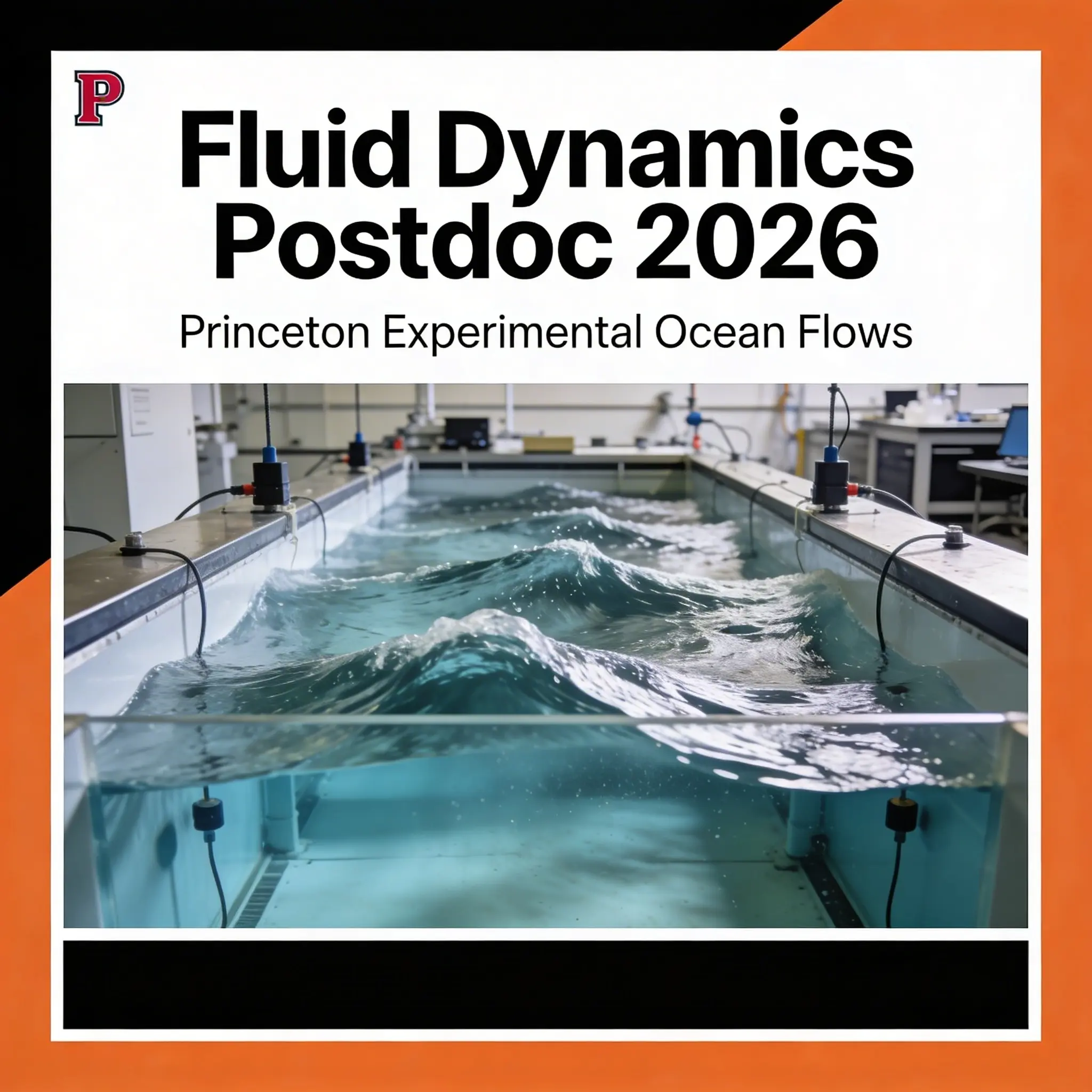
Landing a fluid dynamics postdoc at a world-class institution like Princeton University can transform your research career, especially if you are passionate about experimental ocean flows, environmental pollution, and renewable energy. In 2026, the DiBenedetto Fluids Lab in the Mechanical and Aerospace Engineering Department is offering a rare opportunity to “bring the ocean into the lab,” using cutting-edge wave tank facilities to tackle urgent questions about microplastics, plankton, and marine energy systems. This postdoctoral position is designed for driven researchers who want to lead their own experiments, collaborate across disciplines, and contribute to both fundamental fluid mechanics and real-world environmental solutions.
This Princeton postdoctoral position in fluid dynamics is a fully funded research role in the DiBenedetto Fluids Lab, focused on experimental fluid mechanics with strong links to ocean physics, environmental pollution, ecology, and renewable energy applications.
What does this fluid dynamics postdoc offer?
This role sits in Princeton’s Mechanical and Aerospace Engineering Department and centers on fundamental fluid mechanics in realistic, laboratory-reproduced ocean environments. The successful candidate will lead laboratory experiments on transport processes in wavy, turbulent flows, with the flexibility to tailor the project to their background and interests.
The DiBenedetto Fluids Lab investigates how small particles, organisms, and devices interact with complex ocean surface boundary layers, using a blend of experiments, mathematical modeling, and data science. The lab’s work spans microplastics, sediment, plankton, and wave-energy devices, strongly connecting fluid mechanics with pressing environmental and renewable energy challenges.
Why this fluid dynamics postdoc at Princeton stands out
Princeton’s Mechanical and Aerospace Engineering Department is internationally recognized for fundamental and applied fluid mechanics across scales from microfluidics to ocean waves. Within this ecosystem, the DiBenedetto Fluids Lab focuses on environmental fluid mechanics, studying real-world problems like microplastic transport, plankton dynamics, and wave energy conversion.
The lab uses an advanced wave tank on Princeton’s Forrestal Campus, capable of generating winds and currents over more than fifty feet to mimic realistic ocean conditions. This facility allows you to “bring the ocean into the laboratory” and design experiments that feed directly into better ocean and climate models.
Apply for a PhD assistantship in mechanical and aerospace for Fall 2026
Research themes you might explore in this fluid dynamics postdoc
The advertised postdoc is described as oriented around laboratory experiments, with flexibility regarding the exact project direction. Based on current lab interests, potential themes include microplastic transport in waves and turbulence, wave–turbulence interactions affecting particle settling and rising, plankton motion and environmental transport, and wave energy converter performance in complex seas.
For example, the lab is actively tackling the “missing plastic question,” where observed ocean plastic levels disagree with model predictions due to complex transport and transformation pathways. Experimental insights from this postdoc can help constrain subgrid-scale physics in large ocean models and support environmental policy on plastic pollution and marine renewable energy deployment.
Detailed eligibility breakdown
Eligibility centers on having a strong background in fluid mechanics or closely related fields and a completed doctorate by the appointment start date. Similar postdoctoral roles in ocean and environmental fluid dynamics at Princeton and peer institutions require a PhD in mechanical or aerospace engineering, civil and environmental engineering, applied mathematics, atmospheric and oceanic sciences, geosciences, or another relevant discipline.
From current practice in fluid dynamics postdoc hiring and Princeton’s own postings, you should expect the following core eligibility criteria:
-
PhD completed or nearly completed in mechanical engineering, aerospace engineering, civil and environmental engineering, oceanography, applied mathematics, physics, or a related field.
-
Strong background in fluid mechanics, particularly environmental or geophysical fluid dynamics, multiphase flows, or turbulent transport.
-
Demonstrated experience with laboratory experiments in fluids, including experimental design, instrumentation, data acquisition, and data analysis.
-
Proficiency in at least one scientific programming language, such as Python, MATLAB, or similar, for data processing and visualization.
-
Evidence of research productivity through peer-reviewed publications, conference presentations, or preprints in relevant areas.
Additional desirable qualifications for a competitive application, inferred from comparable fluid dynamics postdoc postings, include experience with imaging techniques, particle tracking, optical diagnostics, or flow measurement methods like PIV. Experience at the interface of experiments and modeling or data-driven methods, such as machine learning for physical systems, is also increasingly valued in ocean and environmental fluid mechanics.
Soft skills matter as well because the role involves leading experiments, mentoring junior group members, and collaborating across disciplines. Strong written and oral communication skills, ability to work independently, and enthusiasm for interdisciplinary environmental problems will significantly strengthen your candidacy.
Application deadlines and timeline
The announcement states that the position can start as early as June 2026, which implies a flexible but time-sensitive recruitment timeline. Princeton and similar programs often review applications on a rolling basis until the position is filled, even when an initial review date is specified on the official ad.
Because the Interfolio posting could update with a priority deadline or closing date, you should treat the following as best practices:
-
Aim to submit a complete application within four to six weeks of seeing the advertisement to be considered in the first review batch.
-
If the Interfolio ad lists a specific “review of applications begins” date, target submission at least one week before that date.
-
Continue checking the Interfolio link to confirm whether the position is still accepting applications before investing significant effort in tailoring materials.
If your schedule permits, plan backward from a desired June–September 2026 start, allowing time for interviews, offer negotiation, visa processing if applicable, and relocation logistics. International candidates should factor in extra time for visa approval and any institutional onboarding processes that may apply.
Apply here (primary contact route)
The formal application must be submitted through Interfolio using the official position link: https://apply.interfolio.com/182189. Interfolio allows you to upload documents, manage reference letters, and track application status centrally.

In addition, the application contact email is: [email protected]. While this address is associated with the announcement rather than Princeton directly, you can use it strategically in two ways:
-
To confirm that you have the correct Interfolio link and that the position remains open before you invest substantial time.
-
To ask logistical questions about the announcement wording, especially if you are unsure about eligibility, start date flexibility, or application components.
For questions about scientific fit, potential projects, or research alignment, you should instead contact Prof. Michelle DiBenedetto directly using the contact information on her Princeton faculty or lab webpage. When reaching out, include a concise CV and a short paragraph explaining why your background and interests align with her group’s work in environmental fluid mechanics.
Step-by-step application guide for this fluid dynamics postdoc
This section walks you through a structured process to prepare and submit a strong application via Interfolio, adapted from common requirements for Princeton fluid dynamics postdoc postings and similar roles.
Step 1: Study the official ad and lab research
Begin by reading the full Interfolio advertisement carefully, noting required documents, preferred qualifications, and any specific research themes mentioned. Then review Prof. DiBenedetto’s faculty profile and lab pages to understand ongoing projects in microplastics, waves and turbulence, plankton transport, and wave energy devices.
Summarize in a brief outline how your PhD work and skills intersect with the lab’s core research questions in environmental fluid mechanics and ocean physics. This outline will anchor your cover letter, research statement, and any optional project ideas you might propose.
Step 2: Tailor your academic CV for a fluid dynamics postdoc
Update your CV to emphasize experience in fluid dynamics, environmental or geophysical flows, laboratory experiments, and quantitative data analysis. Highlight peer-reviewed papers, preprints, and conference talks related to transport processes, turbulence, multiphase flows, or ocean-related topics.
Create clear sections for education, research experience, publications, conference presentations, technical skills, teaching or mentoring, and awards or fellowships. Under technical skills, explicitly list experimental methods you have used, such as high-speed imaging, PIV, microfluidics, or wave tank experiments, along with relevant programming languages.
Step 3: Draft a targeted cover letter
Your cover letter should be concise, typically one to two pages, and tailored specifically to this Princeton fluid dynamics postdoc. Use the opening paragraph to state the position title, the DiBenedetto Fluids Lab, and the Interfolio posting, while briefly indicating your current role and research focus.
In subsequent paragraphs, connect your prior work to at least one or two of the lab’s active topics, such as microplastic transport, particle settling in waves and turbulence, or wave–device interactions. Emphasize how your experimental and data analysis skills will enable you to lead laboratory studies in the wave tank, and mention any experience bridging experiments with modeling or data science.
Step 4: Prepare a focused research statement
Many postdoctoral applications request a research statement, typically in the range of two to four pages, describing past achievements and plans. For this lab, structure your statement to: briefly summarize your PhD thesis and key results, identify a couple of open research questions aligned with the group, and outline specific experimental or methodological ideas you would pursue.
For example, you might propose experiments to quantify microplastic clustering in combined wave–turbulence fields or to investigate settling velocities under varying surface conditions. Clearly explain how your proposed work builds on existing projects in the DiBenedetto Fluids Lab while adding something new that leverages your unique expertise.
Step 5: Line up strong recommendation letters
Interfolio-based postdoc applications typically require three letters of recommendation from advisors or senior collaborators. Identify referees who can speak specifically about your experimental ingenuity, independence in designing fluid mechanics experiments, and your ability to collaborate across disciplines.
Contact them early, share the position description and your drafted materials, and provide a clear deadline for letter submission through Interfolio. Follow up politely to ensure letters are uploaded before review begins, as incomplete files can disadvantage your application.
Step 6: Submit all materials through Interfolio
Create or log into your Interfolio account and navigate to the specific posting at https://apply.interfolio.com/182189. Upload your CV, cover letter, research statement, and any other requested documents, such as a diversity statement or selected publications, using the platform’s stepwise interface.
Add your referees’ email addresses so that Interfolio can request letters directly and track their arrival. Before final submission, double-check document formatting, file labels, and that your contact information is consistent across all materials.
Step 7: Consider a brief, professional inquiry email
After submitting, you may send a concise email to Prof. DiBenedetto to express enthusiasm for the position, mention that you have applied via Interfolio, and highlight in one or two sentences how your work aligns with the lab. Attach your CV and, if appropriate, a one-page research summary, keeping the message short and focused on research fit rather than administrative questions.
For purely administrative or announcement-related clarifications connected to the posting you saw shared, you can use the contact email [email protected], keeping your questions narrow and logistical. This ensures you respect the PI’s time while still clarifying any uncertainties that could affect your application.
FAQs about the Princeton fluid dynamics postdoc
What is the main research focus of this fluid dynamics postdoc?
The position focuses on experimental fluid mechanics in the context of ocean physics and transport processes, especially at the air–sea interface. Projects can involve microplastic transport, particle settling in waves and turbulence, plankton dynamics, and wave energy converter interactions with complex surface flows.
Who is supervising this postdoc?
The postdoc will be supervised by Prof. Michelle DiBenedetto, an assistant professor of mechanical and aerospace engineering at Princeton. Her research combines experiments, mathematical modeling, and data science to understand how small entities interact with wavy, turbulent ocean flows.
What kind of background is ideal?
An ideal candidate has a PhD in mechanical or aerospace engineering, environmental or ocean engineering, applied mathematics, or a closely related field, with strong training in fluid mechanics. Significant experience in laboratory fluid dynamics, including experimental design, measurement techniques, and quantitative data analysis, is highly advantageous.
Is numerical or data-driven experience required?
While the post prioritizes laboratory experiments, experience with numerical modeling or data-driven methods, such as using machine learning to analyze flow data, is an asset. The lab’s broader research program integrates experimental insights with small-scale models and data science to improve ocean and climate simulations.
When does the position start, and how long does it last?
The announcement notes that the position can begin as early as June 2026, with some flexibility depending on candidate availability and administrative timelines. Postdoctoral appointments at Princeton are typically one-year terms, renewable based on performance, funding, and departmental policies, although the precise term length should be confirmed in the official ad or during the offer process.
How competitive is this fluid dynamics postdoc?
Princeton postdoctoral positions in fluid dynamics and related areas attract strong international applicant pools, especially for high-visibility labs. A focused research fit, robust publication record, and clear experimental strengths can distinguish your application even in a competitive field.
Can international candidates apply?
Princeton routinely hires international postdoctoral researchers and supports visa processes when necessary, in line with institutional policy. International applicants should still ensure that they can meet any start-date constraints and allow additional time for paperwork and relocation.
How can I best show fit with the DiBenedetto Fluids Lab?
Demonstrate that you understand the lab’s work by referencing specific themes like microplastic transport, wave–turbulence interactions, or wave energy devices, and explain how your skills complement those topics. Propose one or two concrete research ideas that could realistically be implemented in the lab’s wave tank and linked with ongoing projects.






Leave a Reply