

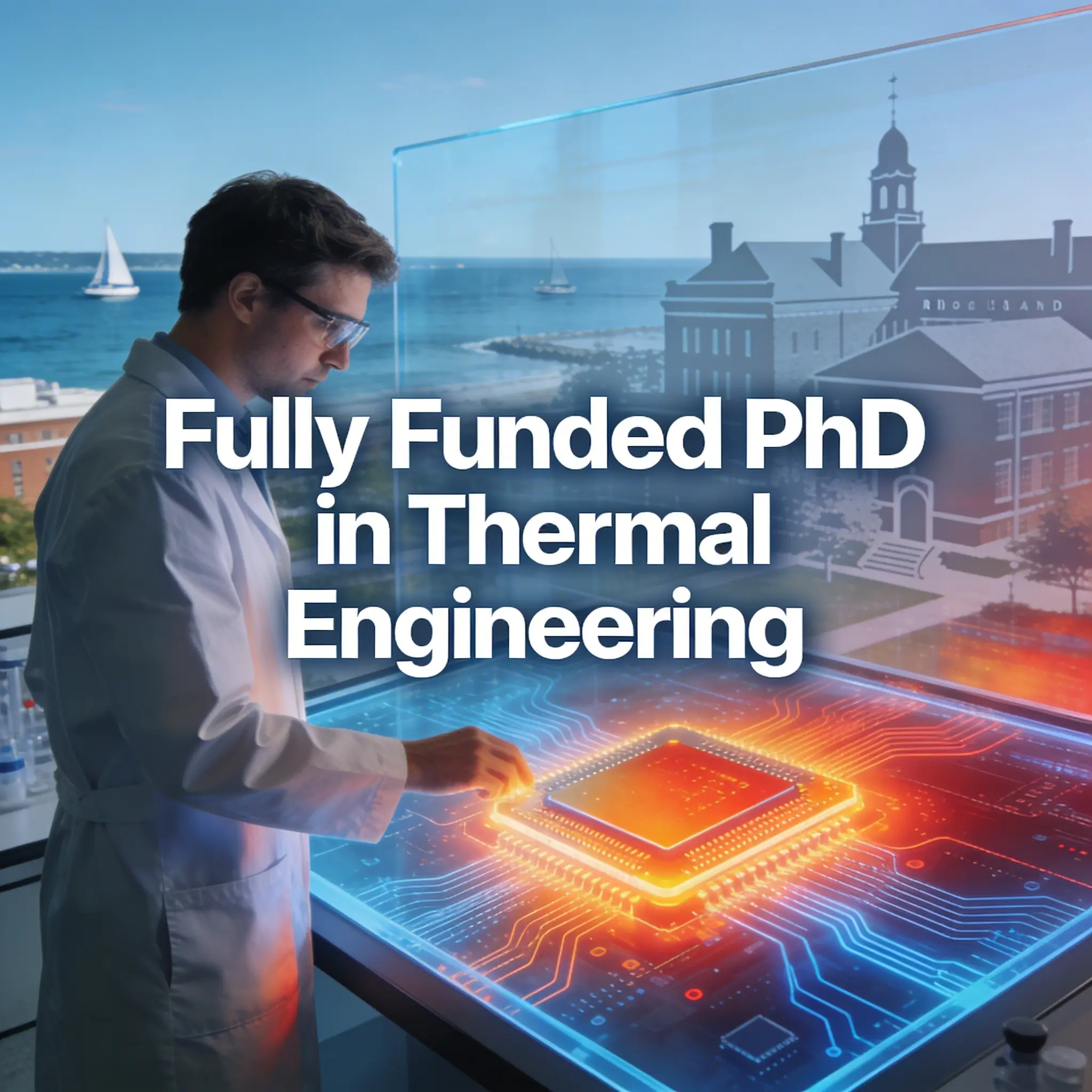
If you are passionate about heat transfer, smart materials, and energy‑efficient technologies, this fully funded PhD opportunity in thermal engineering at the University of Rhode Island could be your game‑changing next step. Joining a brand‑new lab led by an incoming tenure‑track professor, you will work at the forefront of functional thermal materials and systems for advanced electronics cooling, wearables, and sustainable energy applications. With multiple funded positions, flexible start dates from 2026 to 2027, and the resources of a Carnegie R1 public research university, this program offers a rare chance to grow alongside a rapidly emerging research group while building a competitive profile for careers in academia, industry, or national labs.
Why a Fully Funded PhD in Thermal Engineering Is Your Next Big Leap
A fully funded PhD in thermal engineering can transform your passion for heat transfer, materials, and energy sustainability into a long‑term research career. At the University of Rhode Island (URI), incoming tenure‑track Assistant Professor Dr. Ying Cui is building a new research group at the intersection of thermal transport, smart materials, and advanced electronics packaging. This is a rare opportunity to join a lab at its launch, contribute to high‑impact projects, and grow with a rapidly developing research program.
Starting in Fall 2026, Spring 2027, and Fall 2027, the group will recruit highly motivated PhD students with strong backgrounds in heat transfer or materials synthesis who are ready to push the boundaries of functional thermal materials and systems. URI is a Carnegie‑classified R1 public research university located in Kingston, Rhode Island, and offers a collaborative environment, world‑class facilities, and excellent quality of life just minutes from beaches and major New England cities.
Fully Funded PhD in Thermal Engineering: Research Focus and Lab Vision
Dr. Cui’s lab will focus on functional thermal materials and systems with applications in electronic cooling, wearables, and energy technologies. The research spans thermal transport, smart materials, and semiconductor packaging, linking fundamental heat transfer physics with real‑world device challenges. Students will work on projects that enable high‑performance thermal management for next‑generation electronics and sustainable energy systems.
Example topics may include thermal management of semiconductor devices and packages, energy harvesting and conversion using advanced materials, and bioinspired smart systems that adapt to changing environments. Because the group is new, incoming PhD students will help shape lab culture, research directions, and collaborations across the Department of Mechanical, Industrial, and Systems Engineering at URI.
What You Will Work on in a Fully Funded PhD in Thermal Engineering
During your fully funded PhD in thermal engineering at URI, you will engage in both experimental and computational research, depending on your expertise and interests. Potential projects may involve designing and fabricating polymer, crystal, composite, fiber, textile, or gel-based materials with tailored thermal properties for electronics cooling and wearable devices. You may characterize thermal transport using advanced methods, model heat transfer in complex geometries, or optimize semiconductor packaging for high power and reliability.
The lab’s interests also include energy harvesting and conversion, so projects can bridge thermal engineering with emerging energy technologies and smart systems. This combination of materials synthesis, device‑level engineering, and system‑scale thermal analysis will prepare you for careers in academia, national laboratories, and high‑tech industries ranging from microelectronics to clean energy.
Detailed Eligibility Breakdown for the Fully Funded PhD in Thermal Engineering
To join this fully funded PhD in thermal engineering, applicants must meet several academic and background requirements designed to ensure success in a research‑intensive environment. You should hold at least a bachelor’s or master’s degree in mechanical engineering, materials science, chemical engineering, or a closely related field by the time you enroll. Strong fundamentals in thermodynamics, heat transfer, and materials are essential for contributing meaningfully to ongoing and future projects.
Academic Background Requirements
The core degree requirements for the fully funded PhD in thermal engineering are straightforward but demanding. You should have a solid academic record with evidence of excellence in relevant coursework, research projects, or final year theses in areas such as thermal sciences, materials processing, or energy systems. Prior experience with experimental laboratories, numerical simulations, or materials characterization will strengthen your profile considerably when applying.
Desired Technical Skills and Experience
Beyond the degree requirements, the lab is especially interested in candidates with one or more of the following backgrounds. First, experience in heat transfer, either experimental or computational, is highly desirable, including familiarity with techniques like thermal conductivity measurements, thermal imaging, or simulation tools such as CFD or finite element analysis. Second, experience in materials synthesis and fabrication, particularly polymers, composites, or functional films, is strongly valued as the lab explores materials and manufacturing strategies for thermal management.
Additional strengths may include programming skills in Python or MATLAB, prior publications or conference presentations, and familiarity with energy harvesting or electronic packaging. While not mandatory, these experiences demonstrate research readiness and the ability to thrive in a fast‑moving, interdisciplinary environment focused on functional thermal materials and systems.
Soft Skills and Research Mindset
Success in a fully funded PhD in thermal engineering also depends on strong soft skills and the right research mindset. The lab values curiosity, resilience, and the ability to work both independently and collaboratively on complex, long‑term projects. Clear scientific communication, including writing papers and presenting results, will be central as you contribute to publications and conference activities over multiple years.
Applicants should be self‑motivated, comfortable with iterative problem solving, and open to learning new methods in both experiments and computation. Since the group will be newly established, students who enjoy building systems, lab infrastructure, and collaborations from the ground up will find the environment especially rewarding.
Application Deadlines for the Fully Funded PhD in Thermal Engineering
Dr. Cui is recruiting fully funded PhD students with start dates in Fall 2026, Spring 2027, and Fall 2027 to match multiple admission cycles. To maximize your chances of securing a spot, you should plan around typical US graduate application timelines while also contacting the professor early by email. Most US mechanical and materials-related PhD programs have priority deadlines between December and February for fall entry, with earlier contact often essential for funding and visa arrangements.
Recommended Timeline for Fall 2026 Start
For a Fall 2026 fully funded PhD in thermal engineering, you should aim to email your initial inquiry and materials to Dr. Cui between March and September 2025. This early contact allows time for discussion of fit, potential projects, and alignment with the department’s formal application deadlines and funding processes. You should then prepare to submit your official graduate application following the Mechanical, Industrial, and Systems Engineering department’s posted deadlines, which often fall around December or January for US programs.
Recommended Timeline for Spring 2027 and Fall 2027 Starts
If you are targeting Spring 2027, plan to reach out at least nine to twelve months in advance, ideally by early 2026, to coordinate timing and available positions. For Fall 2027, students still in earlier stages of their bachelor’s or master’s degrees can begin planning now, building research experience, and assembling strong application portfolios. Because department deadlines and institutional calendars may change, always verify exact dates and requirements on the official URI and department websites when you are ready to apply.
Apply Here for a Fully Funded PhD in Thermal Engineering
To express interest in this fully funded PhD in thermal engineering, you should initiate contact via email with a concise, well‑organized message.
Send email to Professor Ying Cui [email protected]. Attach your CV, transcript, and brief description of research experience and interest.
Use this email to introduce yourself, share your background, and request more information about available PhD positions and the fit of your profile. A clear subject line and well‑structured message will help your email stand out and make it easier for the faculty member or coordinator to respond efficiently.
What to Include When You Apply for a Fully Funded PhD in Thermal Engineering
When you email to apply for a fully funded PhD in thermal engineering, you should include three core elements as requested in the original call. First, attach your CV highlighting education, GPA, research experience, technical skills, publications, and any awards related to mechanical, materials, or thermal engineering. Second, attach your academic transcript, unofficial or official, depending on what you can access at the initial stage, so the faculty member can quickly assess your academic preparation.
Third, include a brief description of your research experience and interests in the email body or as a short one-page statement, emphasizing alignment with thermal transport, smart materials, or semiconductor packaging. If you have relevant publications, conference talks, or major projects, note them clearly with links or titles so they can be reviewed easily.
Step‑by‑Step Application Guide for the Fully Funded PhD in Thermal Engineering
The following step‑by‑step guide will help you move from initial interest to a competitive application for this fully funded PhD in thermal engineering. By following these stages carefully, you can demonstrate professionalism, preparation, and a strong fit with the lab and department.
Step 1: Study the Research Themes and Align Your Interests
Begin by carefully reviewing the lab’s stated research areas in thermal transport, smart materials, semiconductor packaging, and energy harvesting and conversion. Reflect on which themes excite you most and how your past coursework, projects, or industry experience connect to these topics. Draft a short paragraph summarizing your research interests in thermal engineering and how they align with functional thermal materials and systems.
Step 2: Prepare Your Academic CV and Transcript
Next, update your academic CV to emphasize thermal and materials-related skills, including experiments, modeling, coding, and any fabrication work. Make sure to highlight heat transfer, thermodynamics, materials science, and energy courses, as well as any laboratory or research assistant experience. Download your latest transcript and check that all relevant courses and grades are present and clearly legible for faculty reviewers.
Step 3: Craft Your Research Experience and Interest Statement
Write a concise statement, typically one page or less, describing your past research or project experience and your future interests in thermal engineering. Focus on specific tasks you performed, such as designing experiments, analyzing data, building simulations, or fabricating materials, and what you learned from these experiences. Then explain clearly why you want to pursue a fully funded PhD in thermal engineering at a lab focused on functional thermal materials and systems.
Step 4: Send an Initial Inquiry Email
Compose a professional email to [email protected] with a subject line like “Prospective PhD Applicant – Thermal Engineering – Fall 2026” and a focused message body. Briefly introduce your background, degree, institution, key research experiences, and specific interests in thermal materials, heat transfer, or semiconductor packaging. Attach your CV and transcript, mention that a short research statement is available on request or include it as an attachment, and politely ask about available positions and next steps.
Step 5: Follow Up and Prepare the Official Graduate Application
If you receive a positive response, follow instructions regarding the formal application to URI’s Mechanical, Industrial, and Systems Engineering PhD program. This may include submitting an online application, letters of recommendation, official transcripts, English language test scores, and possibly a more detailed statement of purpose. Use your early correspondence and feedback to tailor your statement and highlight alignment with the lab’s thermal engineering research agenda.
Step 6: Get Ready for Interviews or Meetings
Many faculty members schedule virtual interviews or informal meetings with promising applicants, giving both sides a chance to assess fit. Prepare by revisiting key concepts in heat transfer, thermodynamics, and materials science, and be ready to discuss your past projects in detail. Have thoughtful questions about the lab’s current and planned research, mentorship style, and expectations for PhD students in thermal engineering.
Step 7: Plan for Relocation and Onboarding
Once admitted, plan for visa processing if you are an international student, and coordinate housing and relocation to Kingston, Rhode Island. URI offers a high quality of life with proximity to beaches, nature, and nearby cities like Providence, Boston, and New York City. Before arrival, review foundational material in thermal engineering and materials science, and discuss with your advisor about early research goals and lab onboarding.
FAQs About the Fully Funded PhD in Thermal Engineering
What is the main focus of this fully funded PhD in thermal engineering?
The main focus is on functional thermal materials and systems, especially thermal transport, smart materials, and semiconductor packaging for electronics cooling, wearables, and energy technologies.
Is the PhD fully funded, and what does that typically include?
The positions are advertised as fully funded PhD opportunities, which generally means tuition coverage plus a stipend, subject to departmental and university policies. Exact funding details, including stipend levels and duration, should be confirmed directly with the department and supervising professor during the application process.
What degrees are required to apply?
Applicants should hold a bachelor’s or master’s degree in mechanical engineering, materials science, chemical engineering, or a closely related field. Equivalent degrees in other engineering or physical science disciplines may also be considered if the candidate demonstrates strong preparation in thermal sciences or materials.
Which technical skills are most valued?
Desired backgrounds include heat transfer, both experimental and computational, as well as materials synthesis and fabrication, particularly for functional materials. Skills in numerical modeling, programming, and laboratory instrumentation for thermal measurements are strong advantages.
When can I start the program?
Fully funded PhD in thermal engineering positions are available starting Fall 2026, Spring 2027, and Fall 2027, offering multiple entry points. You should plan your application timeline accordingly and contact the lab at least nine to twelve months before your intended start term.
How do I apply or express interest?
You should email your CV, transcript, and a brief summary of research experience and interests to the listed application contact, currently [email protected] for this blog. Follow any instructions you receive regarding the official URI graduate application process and departmental requirements for the PhD program.
What is it like to study and live at the University of Rhode Island?
URI is a Carnegie‑classified R1 research university and the flagship public institution of Rhode Island, ranked highly among New England public universities. The Kingston campus offers an excellent balance of research intensity and lifestyle, located near beaches, nature reserves, and within short travel distances to Providence, Boston, and New York City.
Can I work on both experimental and computational projects?
Yes, the lab’s scope covers experimental heat transfer, materials synthesis and characterization, and computational modeling, allowing students to pursue combined or focused tracks. Your final project mix will depend on your skills, interests, and evolving research opportunities in functional thermal materials and systems.




Leave a Reply