

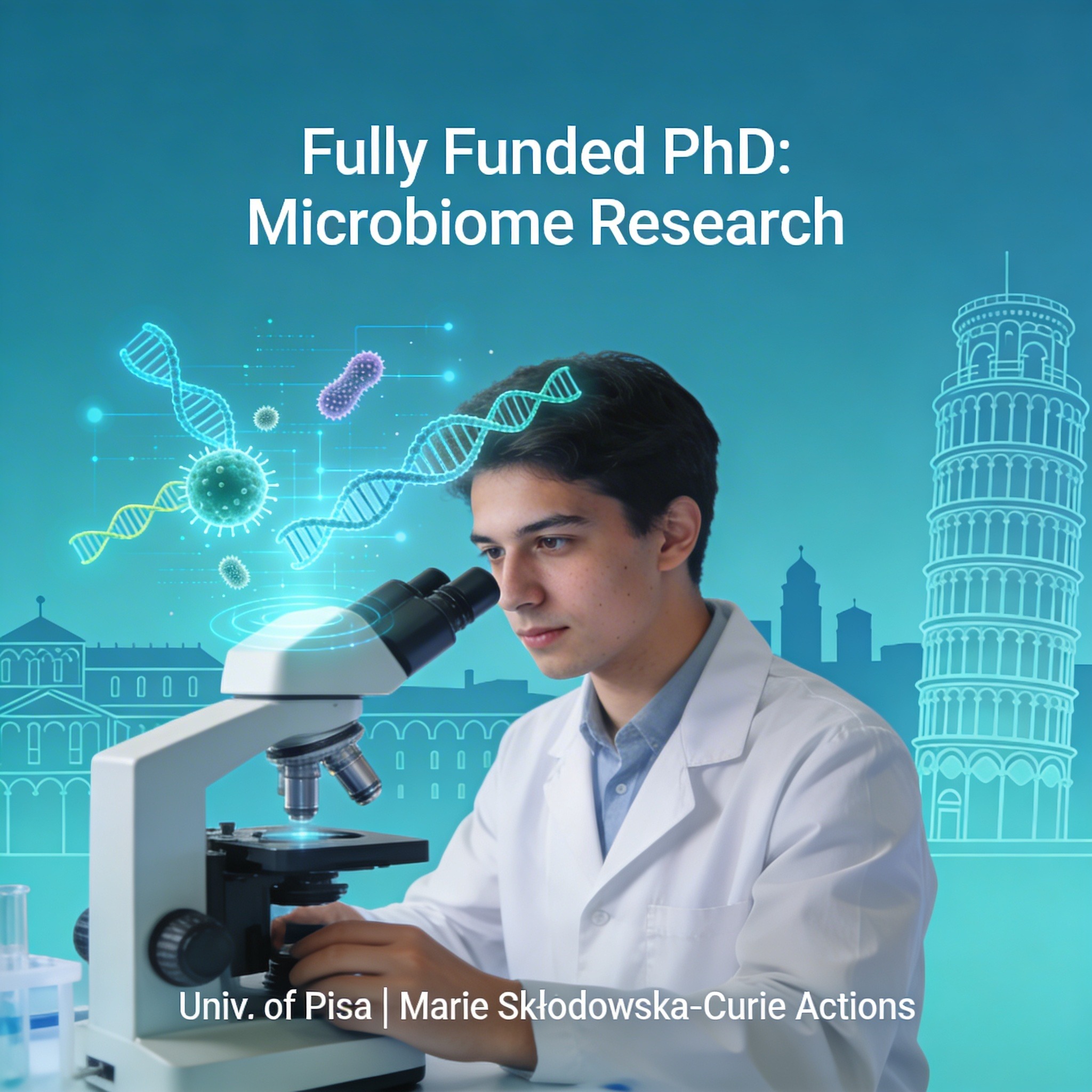
A fully funded PhD position is open at the University of Pisa under the Marie Skłodowska-Curie Actions (MSCA) METAMIC 3 doctoral network, offering three years of intensive, international training in cutting‑edge microbiome research. This opportunity targets motivated graduates in biological and biomedical fields who want to build a global research career in Europe.
Overview of the METAMIC 3 PhD position
METAMIC 3 (Metaproteome-based leveraged microbiome management in the context of One Health) is a European MSCA Doctoral Network focused on understanding microbiomes in humans, animals, and the environment using omics technologies, especially metaproteomics. The network brings together 31 universities, research institutes, and industry partners to train 15 Doctoral Candidates (DCs) in advanced microbiome science.
The University of Pisa is one of the partner institutions hosting a DC within this network and offers a three‑year PhD contract fully funded under the MSCA scheme. As part of the programme, the selected PhD researcher will rotate between multiple European partners, gaining interdisciplinary skills in molecular biology, bioinformatics, environmental science, and translational microbiome research.
Detailed Eligibility Breakdown for the PhD Position
While each host institution specifies its own project‑level requirements, MSCA Doctoral Networks and METAMIC 3 follow a common eligibility framework built around academic background, research potential, and mobility rules. Below is a practical breakdown tailored to the University of Pisa METAMIC 3 PhD position you want to feature.
1. Academic Qualifications for the PhD Position
-
A completed Master’s degree (or equivalent) in one of the following or closely related fields:
-
Biological Sciences
-
Biotechnology
-
Pharmacy
-
Bioinformatics
-
Translational Research or related biomedical disciplines
-
-
The degree must be obtained before the start of the PhD contract, which is typically aligned with the 2026–2027 academic year for this call.
-
A strong foundation in molecular biology, microbiology, or omics‑related methods is highly desirable, since METAMIC 3 explicitly focuses on microbiome research and metaproteomics.
2. Research Skills and Experience for the PhD Position
-
Previous research experience (e.g., Master’s thesis, lab internships, or research assistant roles) in one or more of the following areas is a major advantage:
-
Microbiome or microbial ecology
-
Metagenomics, metaproteomics, or other omics technologies
-
Bioinformatics and data analysis
-
Clinical or translational research in life sciences
-
-
Evidence of scientific writing (e.g., thesis, reports, posters, or publications) strengthens competitiveness in MSCA networks.
3. MSCA Mobility Rule for the PhD Position
MSCA Doctoral Networks apply a specific mobility rule, which also covers METAMIC 3 positions:
-
Applicants must not have resided or carried out their main activity (work, studies, etc.) in Italy for more than 12 months in the 36 months immediately before the application deadline.
-
This rule ensures international mobility and is non‑negotiable: candidates who do not meet it are considered ineligible even if they fit the academic profile.
4. Language Requirements for the PhD Position
-
A very good command of English (written and spoken) is essential, as METAMIC 3 is an international network and PhD training, supervision, and publications are conducted in English.
-
Knowledge of Italian is beneficial for local integration at the University of Pisa, but is not typically a formal requirement for MSCA Doctoral Networks.
5. Personal and Professional Competencies for the PhD Position
-
Demonstrated motivation for international research mobility and willingness to spend research stays (secondments) at partner institutions across Europe.
-
Ability to work in interdisciplinary teams, bridging biology, computational data analysis, and One Health applications.
-
Strong organizational skills, self‑motivation, and interest in building a long‑term academic or industry research career in microbiome science.
Sustainable Crop Protection & Bio‑Based Materials: 8 Funded PhD
Application Deadlines
For the specific University of Pisa PhD position within METAMIC 3, the online call highlights 16 March 2026 as the application deadline. This aligns with the typical EU doctoral network timeline, where calls are issued several months before the program starts to allow time for evaluation, interviews, and enrollment.
Key dates to keep in mind (indicative structure based on similar calls in Italy and MSCA‑linked programs):
-
Call open: Early 2026 (the METAMIC 3 network itself officially launched in late 2025).
-
Application deadline: 16 March 2026 (as mentioned in the shared announcement).
-
Shortlisting and interviews: Typically conducted in the weeks following the deadline, often within 1–2 months.
-
Expected start: Beginning of the 2026/2027 academic year, usually between autumn 2026 and early 2027, depending on the University of Pisa’s PhD calendar.
Always verify exact dates and any extensions on the official METAMIC 3 and University of Pisa pages, as only those platforms can publish binding updates.
Apply for the PhD position. Here
Candidates must apply by sending an email to [email protected]
Step-by-Step Application Guide
To help your audience, you can outline a clear, SEO‑friendly step‑by‑step guide that mirrors how MSCA Doctoral Network positions are typically handled in Italy and across Europe.
1: Confirm Eligibility
-
Check that your master’s degree matches one of the approved disciplines (biological sciences, biotechnology, pharmacy, bioinformatics, translational research, or closely related areas).
-
Verify you satisfy the MSCA mobility rule (no more than 12 months in Italy over the last 36 months before 16 March 2026).
-
Ensure you can provide official transcripts, degree certificates, and proof of English proficiency if requested.
2: Study the METAMIC 3 and Pisa Project Description
-
Visit the METAMIC 3 website and read the scientific summary of the network’s objectives, specifically its focus on metaproteome‑based microbiome management in the One Health context.
-
Identify the specific Pisa‑based PhD project: note the scientific aims, methodologies (e.g., metaproteomics, omics integration, and bioinformatics), and planned secondments.
-
Reflect on how your academic and research experiences align with this project to tailor your application documents effectively.
3: Prepare Your Application Documents
Typical MSCA Doctoral Network applications request a structured package similar to the following:
-
Curriculum Vitae (CV) with education, research experience, skills, and any publications or conference presentations.
-
Motivation letter or statement of purpose explaining why you want this PhD position, how you fit METAMIC 3, and what you bring to the University of Pisa’s project.
-
Short research statement aligning your interests with microbiome, omics, and One Health themes.
-
Academic transcripts and degree certificates from your Bachelor’s and Master’s degrees.
-
Contact details for two or more referees who can provide recommendation letters, often requested directly by the institution.
Some MSCA‑related calls in Italy and elsewhere also ask for a self‑declaration of eligibility or mobility compliance, similar to the MSCA masterclass and PF schemes.
4: Prepare for Possible Interviews
-
Shortlisted candidates for MSCA Doctoral Networks are usually invited for an online or on‑site interview focusing on scientific background, motivation, and fit to the project.
-
You may be asked to present your master’s thesis, discuss your research ideas within the METAMIC 3 framework, or comment on how you would handle international mobility and secondments.
-
Interview outcomes and final selection decisions are then communicated individually, as required by European and institutional procedures.
Why This PhD Position Is a Strong Career Move
This University of Pisa METAMIC 3 PhD position combines the advantages of a traditional doctoral program with the benefits of a structured European network funded by MSCA. Some distinctive strengths you can highlight in your blog include:
-
Fully funded for three years with a competitive MSCA salary, allowances, and social security coverage, making it financially sustainable for international candidates.
-
Embedded in a one health framework, linking human, animal, and environmental microbiomes and making the research highly relevant for health, agriculture, and sustainability.
-
Access to cutting‑edge technologies such as advanced mass spectrometry, metaproteomics workflows, and multi‑omics data analysis.
-
Strong international collaboration, with secondments to leading institutions across Germany, the Netherlands, Belgium, Luxembourg, Spain, and other EU countries.
-
High employability: MSCA doctoral alumni are highly valued in academia, biotech, pharma, health agencies, and data‑driven life science companies.
FAQs about the PhD position
You can structure your FAQ section around the questions most relevant to “PhD position” searches and MSCA‑style calls.
1. What is the METAMIC 3 project about?
METAMIC 3 stands for “Metaproteome‑based leveraged microbiome management in the context of One Health”. It aims to understand how microbial molecules and microbiome dynamics across humans, animals, and environments can be harnessed to improve health, agriculture, and ecological sustainability using metaproteomics and other omics technologies.
2. Is this PhD position fully funded?
Yes, METAMIC 3 is funded by the European Union through the Marie Skłodowska‑Curie Actions under Horizon Europe, with around €4.4 million supporting 15 PhD positions across the network until 2029. The University of Pisa position is part of this network and offers a fully funded, three‑year PhD contract, including salary and social benefits according to MSCA rules.
3. Who can apply for the PhD position?
Graduates with a Master’s degree (or equivalent) in Biological Sciences, Biotechnology, Pharmacy, Bioinformatics, Translational Research, or closely related fields can apply, provided they meet the MSCA mobility rule and any additional institutional criteria set by the University of Pisa.
4. Do I need research experience in microbiomes before applying for the PhD position?
Previous microbiome, omics, or bioinformatics experience is not always mandatory but is highly advantageous and may significantly improve your chances of selection. The project is at the forefront of microbiome and metaproteomics research, so a solid foundation in molecular biology, microbiology, or computational biology is strongly recommended.
5. What is the MSCA PhD position mobility rule and how does it affect me?
The MSCA mobility rule states that you must not have lived or worked in Italy for more than 12 months in the 3 years immediately before the application deadline (16 March 2026 for this call). If you exceed this limit, you are ineligible for this specific MSCA Doctoral Network position, even if you are otherwise qualified.
6. What is the duration for the PhD position?
The PhD contract associated with this METAMIC 3 position is for three years, which is standard for MSCA Doctoral Network projects and aligns with the network‑wide training plan and rotations.
7. Will I have to move during the PhD?
Yes, mobility is a core component of METAMIC 3. Each Doctoral Candidate undertakes secondments to partner institutions in other European countries for defined periods, obtaining interdisciplinary and cross‑sectoral training. You will be based primarily at the University of Pisa but spend some months in other labs across the network.
8. What career paths does this PhD position open?
Graduates from MSCA Doctoral Networks like METAMIC 3 are well positioned for careers in:
Academic research and postdoctoral fellowships in microbiome, metaproteomics, and One Health.
Biotech and pharma companies developing microbiome‑based diagnostics, therapeutics, or agricultural solutions.
Public health agencies, environmental organisations, and regulatory bodies where microbiome and One Health insights are increasingly valued.
9. How competitive is MSCA PhD position?
MSCA Doctoral Network positions typically attract a high number of applications worldwide due to their funding, training quality, and international exposure. A strong academic record, clear motivation, and good alignment with the METAMIC 3 project can significantly increase your chances.
10. Where can I get more information about the PhD Position?
METAMIC 3 project website and social media updates for scientific background, partner list, and links to all 15 PhD positions.
University of Pisa’s official PhD/doctoral pages for call text, application portal, and institutional requirements.
Marie Skłodowska‑Curie Actions website for general rules, funding principles, and mobility criteria.









Leave a Reply