

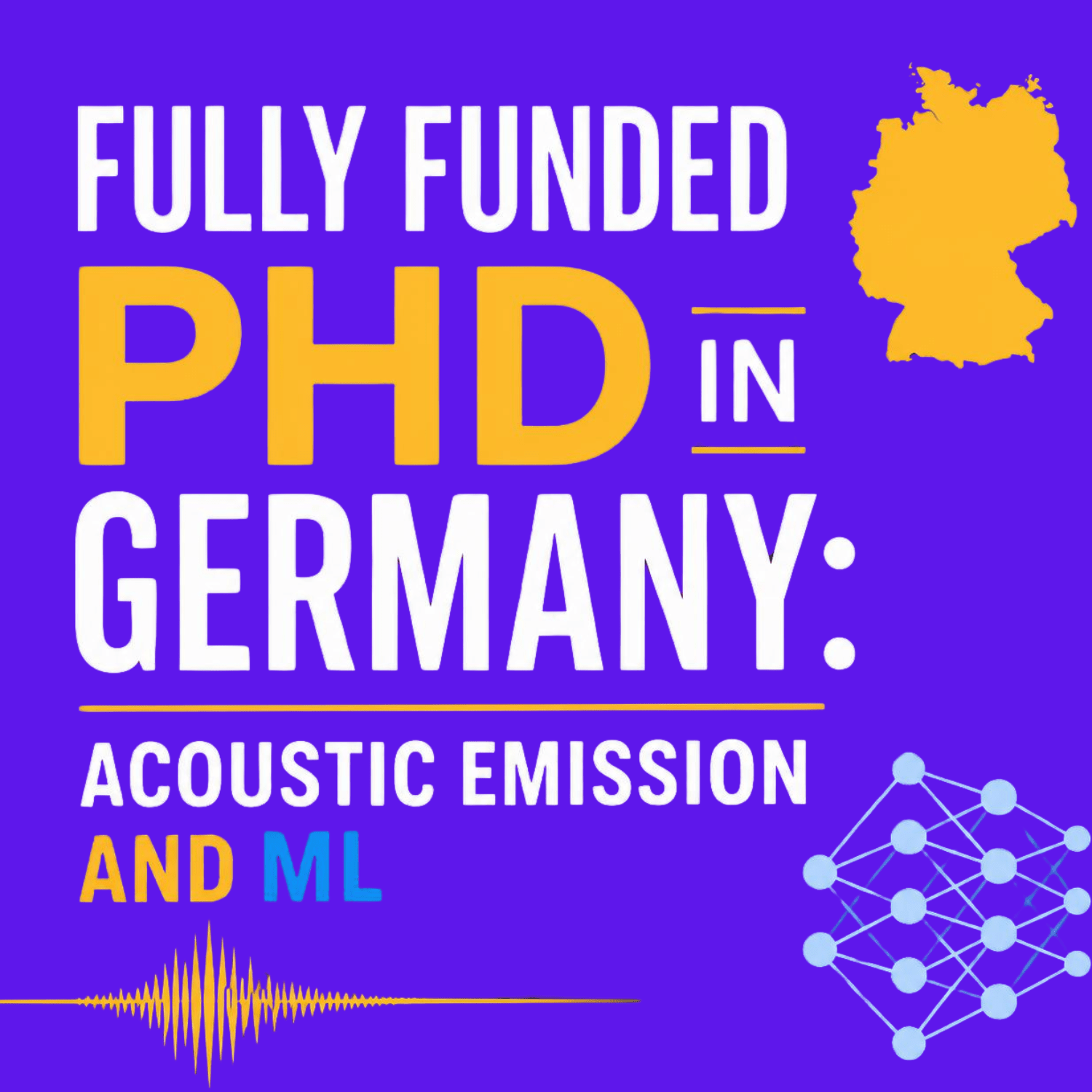
At a time when safety of infrastructure is becoming ever more data-driven, the combination of sensor technology and machine learning is transforming the way we detect and forecast failures in materials. Now, the opening of a fully funded PhD position in acoustic emission by Bundesanstalt für Materialforschung und -prüfung (BAM), Germany, is positioned right at this confluence, making it a very interesting prospect for those working in materials science, NDT, and artificial intelligence.
Acoustic Emission PhD Quick Overview
- Location: Berlin, Germany
- Length of contract: 3 years (contract financed until mid-2029)
- Position: PhD or Postdoc
- Salary: TVöD E13 (German Civil Service Scale)
- Closing date for applications: 28 July 2026
- Topics of research: Acoustic Emission, Structural Health Monitoring
Acoustic Emission PhD Project Background
This position forms part of the SHIELD program within the framework of the Euratom CONNECT-NM project through the partnership of major institutions like CEA, KU Leuven, University of Bologna, EDF, and Westinghouse.
SHIELD focuses on developing methods of long-term structural health monitoring for nuclear plants. In view of the high safety considerations and longevity of such structures, any degradation has to be detected early enough. The approach that will be taken by this program will involve AE sensing and data analysis.
Acoustic Emission PhD Research Scope
PhD work involves exploiting acoustic emissions that are transient elastic waves resulting from microstructural modifications such as cracking and crack growth.
Main research aspects are:
-
Acoustic Emission Analysis
Detection and interpretation of elastic waves generated by damage mechanisms in materials.
-
Signal Processing
Filtering noise, extracting meaningful features, and transforming raw AE signals into usable datasets.
-
Machine Learning Applications
Developing algorithms for event detection, clustering, and classification of damage signatures.
-
Source Localization
Identifying the origin of acoustic events within large and complex structures.
-
Experimental Campaigns
Dealing with practical datasets obtained from experimental settings in laboratories and field testing on concrete and high-temperature systems.
It’s a perfect case for physics-driven data science, where knowledge about wave propagation is equally essential as model construction itself.
Skills and Background: What They Are Really Looking For
While the listing mentions mechanical engineering, materials science, or related fields, the underlying requirements translate into a few core competencies:
- Background in signal processing (frequency-based approaches, filtering)
- Background in machine learning (classification, clustering, possibly neural networks)
- Skills in programming (MATLAB/Python)
- Knowledge about wave propagation in solids (bulk and guided waves)
- Knowledge of non-destructive testing methods (e.g., acoustic emission, ultrasound)
It should be noted that candidates with experience working in data-intensive experimental sciences like electrochemical systems may be able to leverage their expertise, especially in analysis.
Why This Opportunity Stands Out
Several factors make this job highly desirable:
- Real access to industrial and field data on nuclear installations
- Work in collaboration with the best European research and industrial institutions
- High level of integration between experimental studies and machine learning
- Location within the facilities of BAM, the premier organization in materials safety and testing
- Advanced digitalization facilities, research data management, and artificial intelligence in scientific research
This PhD is not just theory-based. It has a direct application purpose.
Who Should Consider Applying
This opportunity is a strong fit if you:
- Experience with Materials Science, Mechanical Engineering, or Applied Physics
- Like being at the intersection of experiment and data interpretation
- Experience in signal-based methods (AE, ultrasonics, EIS)
- Interested in Machine Learning applied to physical systems
Although you may have studied electrochemistry or energy storage previously, the similarities between signal processing and degradation analysis make this a feasible career change.
Application Tips: Positioning Yourself Strategically
Applicants are advised to:
- Focus on experience with signal processing (including EIS or equivalent)
- Focus on machine learning projects (such as ANN applications or classifications)
- Show your capabilities working with experimental data flow
- Highlight anything dealing with waves, sensors, and diagnostic measurements
In case you have experience in EIS, then you should consider it under the topic of frequency domain analysis of signals and feature extraction.
Application Details
- Application Deadline: 28 July 2026
- Organization: Bundesanstalt für Materialforschung und -prüfung (BAM)
- Country: Germany, Berlin
CLICK HERE for more information
Final Insight
The present PhD thesis also exemplifies a paradigm shift that is taking place in the field of materials science research, where sensing technology, physics, and machine learning converge to predictively maintain infrastructure. For anyone who wishes to take research beyond materials science into data-driven monitoring systems, the following represents an interesting approach.
Frequently Asked Questions (FAQ)
1. Is this position suitable for candidates without prior acoustic emission (AE) experience?
Certainly, but with a caveat. Although hands-on knowledge in AE is more desirable, individuals who have expertise in other methods like ultrasonics, guided waves, and even EIS can be considered as well, provided they have good skills in signal processing and data analysis.
2. Can candidates from electrochemistry or energy storage research apply?
Absolutely. Even though the field of application is not the same, there is considerable similarity between signal analysis, interpretation of data, and machine learning. Having experience in dealing with complex experimental data sets and working with the frequency domain makes you qualified.
3. What programming skills are expected for this PhD?
Knowledge of MATLAB or Python is a must for this position. The candidate should also have experience using signal processing software tools, machine learning frameworks, and data management workflows.
4. How important is machine learning experience for this role?
Machine learning forms an essential part of the work here. The applicant should be able to handle activities like classification and clustering and even possibly neural networks. Practical experience is better than theoretical knowledge.
5. Is knowledge of wave propagation essential?
Yes. Knowledge of elastic wave propagation in solids (bulk and guided waves) is explicitly needed since it is fundamental to the study of acoustic emissions and source localization.
6. Do I need to know German to apply?
No. The ability to speak English is enough for this job. But basic knowledge of the German language will be an additional advantage.
7. What kind of experimental work is involved for an acoustic emission PhD?
The project involves lab and field experiments on concrete constructions and high-temperature systems. The use of sensors, data collection systems, and field applications is probable.
8. Is acoustic emission PhD more computational or experimental?
This position requires a combination of practical work with analysis and machine learning. It is one of the main advantages of the position.
9. What makes acoustic emission PhD different from typical materials science PhDs?
Such a profession is very interdisciplinary in nature. As opposed to looking at materials either synthesis or characterization alone, it looks at real-time monitoring, sensing, and diagnostics of large infrastructure.
10. What are the career prospects after completing acoustic emission PhD?
Such students will have excellent employment opportunities in the following:
- Structural health monitoring (SHM)
- Non-destructive testing (NDT)
- Energy and nuclear sectors
- Data-based materials engineering
- Machine learning applications in engineering systems
11. Is prior experience with nuclear materials required for acoustic emission PhD?
No. The emphasis is not on nuclear chemistry or reactor physics but on the monitoring methods and data analysis.
12. How competitive is the acoustic emission PhD?
Very competitive due to the money, cooperation between other countries, and location itself. A good technical match (signal processing + ML + experiments) will be crucial in making a difference.



Leave a Reply