

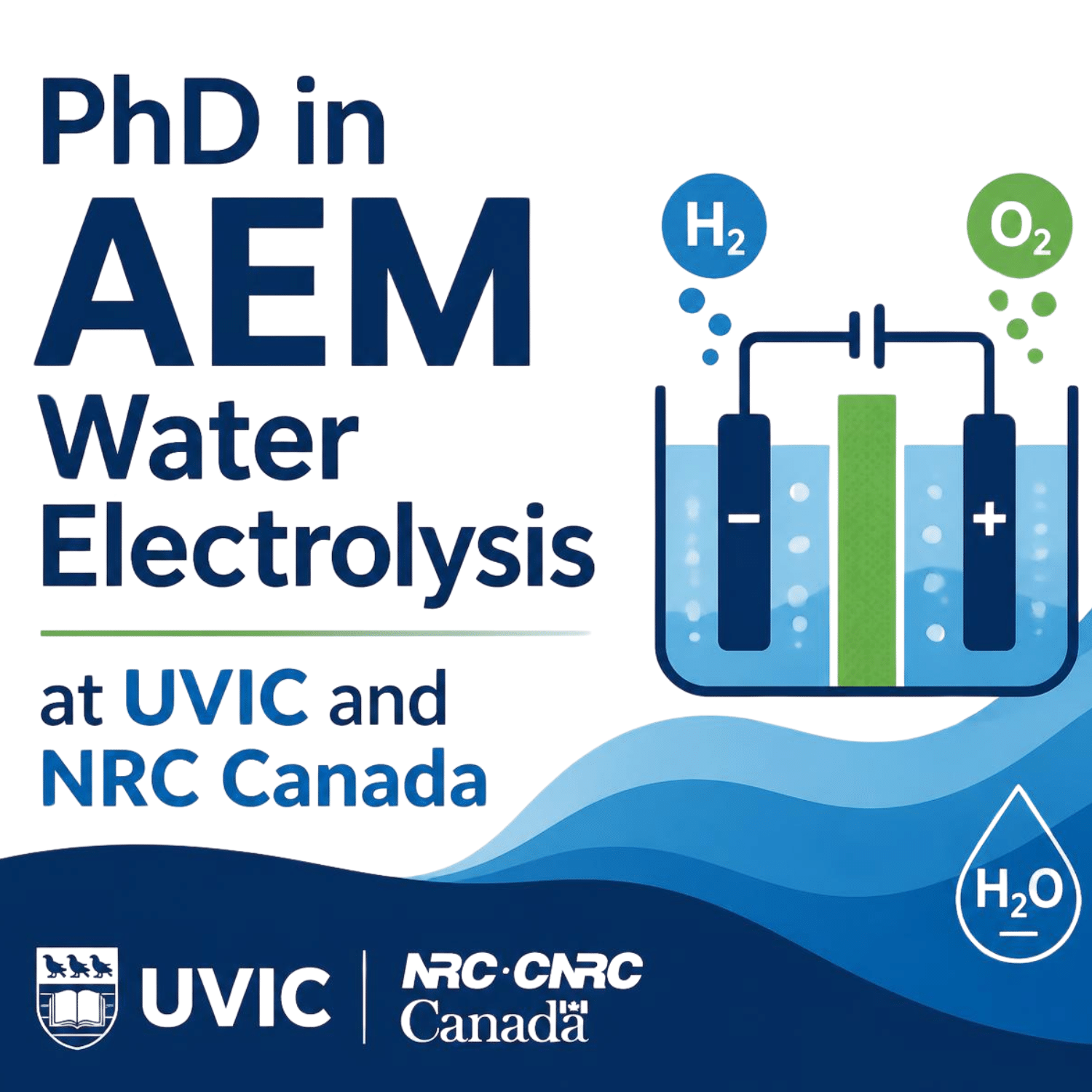
The UVic Energy Group for Generation and Storage (EGGS) invites highly motivated Ph.D. students to participate in a joint research project between EGGS and the National Research Council of Canada (NRC Canada / Conseil national de recherches Canada). The research project will be centered on next-generation water electrolysis, with special attention to catalyst and ionomer development for anion exchange membrane (AEM) water electrolyzers.
This project would be ideal for candidates with a chemical engineering, mechanical engineering, materials engineering, or similar background interested in undertaking Ph.D. studies in the areas of hydrogen generation, electrocatalysis, electrochemical energy conversion, and advanced functional materials.
Water Electrolysis PhD Overview
About the PhD in AEM Water Electrolysis
The PhD research program would assist in developing state-of-the-art catalyst and ionomer materials for anion exchange membrane water electrolyzers. Water electrolysis is a technology of splitting water to produce hydrogen through electrical energy input. When driven by renewable electrical energy, electrolytic hydrogen could help in achieving environmentally friendly industries, energy storage, and transportation applications, among others.
Anion exchange membrane water electrolysis is an important new area of research as it seeks to achieve efficient hydrogen production while using cheaper and more abundant catalyst materials than some of the known electrolyzer systems. Nevertheless, there is still a need for improvement in catalyst activity, catalyst layer architecture, ionomer properties, electrode production, and durability.
The selected PhD candidate would be involved in catalyst preparation, electrode and functional materials development, materials characterization, and performance and durability testing of AEM electrolyzer materials and components under the collaboration of UVic and NRC Canada research programs. The research combines basic materials science and electrochemical engineering applications.
PhD in AEM Water Electrolysis Key Responsibilities
Some of the research activities for which the chosen PhD student will participate include:
- Development of high-performance catalyst layers and functional materials for AEM water electrolysis.
- Preparation and fabrication of catalyst and electrode materials.
- Physical characterization of synthesized materials and components.
- Electrochemical studies for the evaluation of the performance of developed materials and electrode designs.
- Evaluation of durability of materials and components used for AEM electrolyzer.
- Publication of scientific work.
This viewpoint is particularly appealing to scientists who would like to pursue research work involving materials synthesis and electrochemical evaluation of hydrogen-energy systems.
PhD in AEM Water Electrolysis Required Qualifications
Applicants are supposed to fulfill the following criteria:
- Possess a master’s degree in mechanical engineering, chemical engineering, materials engineering, or any other closely related field.
- Possess previous laboratory experience in the laboratory about water electrolysis and/or fuel cells.
- Satisfy the criteria for graduate studies at the University of Victoria.
- Show excellent oral and written communication abilities.
- Be willing to take part in writing and publishing activities.
Preferred Skills and Experience
While not all the listed qualifications may be necessary, candidates with the following background could be especially competitive:
- Synthesis of electrochemical elements, including electrodes, catalyst layers, MEAs, and related elements.
- Knowledge of electrochemical testing of the properties and performance of electrochemical elements.
- Knowledge of physical and surface characterization techniques such as SEM, XPS, XRD, and XRF analysis.
- Scientific research experience in electrocatalysis, fuel cells, water splitting, hydrogen technologies, energy materials, membranes, or related electrochemical systems.
- Experience in scientific publishing, conference presentations, or technical report writing.
Candidates living in Canada can be given preference according to the announcement.
Who Should Apply?
The PhD position will suit candidates with an academic/research background in one or more of the following areas:
- Electrocatalysis and Catalyst Design.
- Hydrogen Generation and Water Splitting.
- Fuel Cells and Electrolyzers.
- Electrochemical Energy Storage Devices, e.g., batteries and supercapacitors.
- Functional Materials, Porous Materials, Membranes, and Ionomers.
- Fabrication of Electrodes and Electrochemical Device Assembly.
- Electrochemical methods like cyclic voltammetry, Impedance Spectroscopy, Polarization Studies, and Durability Testing.
- Characterization of Materials by SEM, XRD, XPS, XRF
Individuals lacking experience in AEM electrolyzers could still qualify as suitable applicants provided that they have been able to prove their transferability of skills in electrochemical energy storage, corrosion, electrodes, catalysis, membranes, or other related energy-materials science areas.
PhD in Computational Catalysis at Wilfrid Laurier University
How to Apply
The following are required from interested candidates:
- Current Curriculum Vitae (CV).
- Cover Letter Customized to the Position.
- Transcripts of Academic Work.
- Three Reference Names.
All documents have to be merged in a single PDF file and emailed to:
Jason Lee
Email: [email protected]
Applicants must include the following text in the email subject line: [Application-EGGS]
Tips for a Strong Application
There is a possibility that a general application can be relatively less effective than a targeted one in the case of an electrochemistry PhD position.
In the cover letter, applicants should specify:
- Reasons why AEM water electrolysis and hydrogen generation excite them.
- Any background knowledge or experience they have in electrochemical systems, materials science, or experimentation.
- Any electrode preparation, catalyst production, membrane work, fuel cell testing, or electrolyzer work.
- Any experience with characterization equipment such as SEM, XRD, XPS, and XRF, as relevant.
- Any electrochemical technique experience, such as performance evaluation, impedance measurements, cyclic voltammetry, or durability testing.
- Experience with any research that will help them with independent PhD-level research and publishing.
For candidates specializing in supercapacitors, batteries, corrosion, biomass-based carbons, or other electrochemistry/materials science disciplines, it may be valuable to highlight transferable skills including electrode fabrication, electrolyte choice, electrochemical testing, surface characterization, data analysis, and scientific writing.
Final Thoughts
A PhD position at the University of Victoria in collaboration with NRC Canada will give the applicant the chance to join an exciting field of clean energy research, which involves enhancing materials/components for hydrogen generation using AEM water electrolysis. This position will expose the candidate to areas such as catalyst development, electrode preparation, materials characterization, electrochemical measurements, durability testing, and academic publishing.
Anyone interested in hydrogen technology with a master’s degree in engineering/materials science and laboratory experience in water electrolysis/fuel cells is encouraged to prepare a specific application. It should be ensured before submitting the application that all the needed documents are incorporated into a single PDF file, using the required subject for the email, as well as the current deadline for the application.




Leave a Reply