

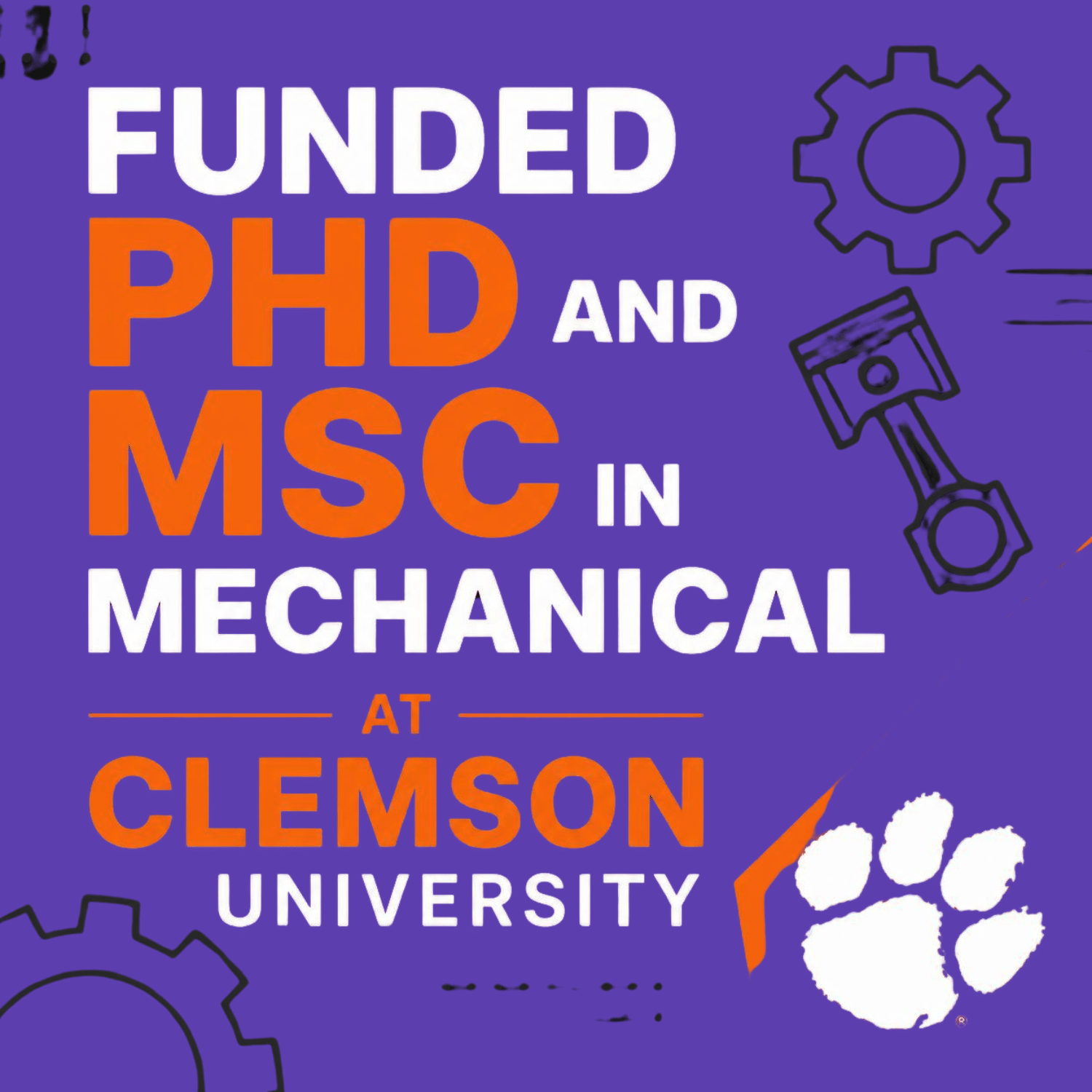
Funded PhD and MSc opportunities at Clemson University for Fall 2027. Join the Waves and Intelligent Metamaterials Lab. Applications for graduate studies in Fall 2027 are sought from interested individuals by the Waves and Intelligent Metamaterials Lab in the Department of Mechanical Engineering at Clemson University. Applications for MSc and Ph.D. degrees will be accepted; all qualified Ph.D. applications will be fully funded.
Table of Contents
ToggleThe group, under the leadership of Prof. Patrick Dorin, explores wave control in elastic waves, vibrations, and information transmission via mechanically engineered structures.
Funded PhD and MSc Summary
| Item | Details |
|---|---|
| University | Clemson University |
| Department | Mechanical Engineering |
| Research group | Waves and Intelligent Metamaterials Lab |
| Entry term | Fall 2027 |
| Degree levels | MSc and Ph.D. |
| Funding | Full funding available for Ph.D. applicants |
| Main areas | Vibrations, elastic metamaterials, intelligent structures, mechanical computing, nonlinear dynamics, and wave propagation |
| Prospective supervisor | Prof. Patrick Dorin |
| Contact email | [email protected] |
Funded PhD and MSc Research focus
Metamaterials Lab focuses on developing architected mechanical metamaterials: materials whose properties depend not just on their composition but on their geometry, connectivity, and lattice architecture as well. Metamaterials can be designed in such a way that they would affect vibrations and elastic waves in one way or another.
Research topics include:
- Theoretical modeling of mechanical system dynamics, structural dynamics, vibrations, waves, and phononic band structure.
- Numerical modeling by means of programming languages like MATLAB or Python in combination with finite element software such as COMSOL.
- Experimental mechanics consisting of CAD modeling, laser cutting, computer numerically controlled (CNC) machining, 3D printing, architected structure fabrication, and vibration measurements.
- Mechanical computing in elastic metamaterials involving the design of structures capable of neuron-like information processing or engineering specific nonlinear properties of elastic waves.
- Topological elastic metamaterials involving concepts from the theory of topological phases of matter for providing robust channels for mechanical waves and vibrations.
A larger vision for the lab is to use wave mechanics, mechanical intelligence, and topological physics in order to develop materials and structures that will be able to control the transport of vibrations. This involves analytical modeling, computational work, and experimentation.
Postdoctoral and PhD in Advanced Materials and Nuclear Energy
Who should apply for the Funded PhD and MSc?
This chance might prove particularly appropriate for those with a background or interest in:
- Mechanical Engineering
- Materials Science & Engineering
- Applied Physics
- Structural Dynamics & Vibrations
- Computational Mechanics
- Solid Mechanics
- Metamaterials & Phononics
- CAD, Additive Manufacturing, or Experimental Mechanics
- MATLAB, Python, COMSOL, or Finite Element Analysis
- Nonlinear Dynamics, Wave Physics, or Topological Materials
The applicants may not have expertise in all fields. They should, however, show clear motivation to carry out research in an interdisciplinary manner using theoretical knowledge, computing, and experiments.
For example, an applicant who has a background in materials science, porous materials, energy storage devices, and scientific machine learning can write about transferable skills including materials characterization, data analysis, modeling, experimentation, fabrication, and programming. The important thing is to show how this will contribute to research in architected materials and vibration control technologies.
How to apply for the Funded PhD and MSc
Interested students must do the following:
-
Examine the Waves and Intelligent Metamaterials Laboratory website and find research areas that align with their background and professional aspirations.
-
Create a CV for your academic credentials that emphasizes research, technical experience, articles published, courses taken, programming, simulations, fabrication, or experiments.
-
Email Prof. Patrick Dorin at [email protected] with:
- Your CV or résumé
- A brief description of your research experience
- An explanation of why your interests fit with the lab’s direction
- The degree you plan to obtain: MSc or Ph.D.
- Your availability for Fall 2027
-
Apply officially using the graduate application procedure for mechanical engineering at Clemson University.
-
Express your desire to become a part of the Waves and Intelligent Metamaterials Laboratory in your application documents, particularly your statement of purpose.
The lab’s public recruitment notice specifically asks candidates to send their résumé/CV and describe how their background and interests align with the group’s work, while also completing Clemson Mechanical Engineering’s formal graduate application process.
Frequently Asked Questions
1. Which programs are available for the Funded PhD and MSc?
Clemson University’s Waves and Intelligent Metamaterials Lab is looking for MSc/Ph.D. graduate students to join for Fall 2027 admissions in Mechanical Engineering. Applicants are requested to convey their interests to be considered for the research program through the university’s graduate admissions process.
2. Is funding available for Ph.D. students?
Yes. As per the recruiting flyer, there is full funding for Ph.D. applicants. Since the funding is based on the acceptance of the applicant, project availability, and other conditions, it would be better to contact Prof. Patrick Dorin himself about this matter.
3. Are MSc. students eligible to apply?
Yes. The laboratory is open to applications from both MSc and Ph.D. applicants who have an interest in the areas of vibration, mechanical metamaterials, smart structures, and wave propagation. The poster clearly states full funding for Ph.D. applicants, but nothing about MSc applicants.
4. What research topics can students work on for the Funded PhD and MSc?
Possible avenues for future research could be:
- Metamaterials: mechanical and elastic
- Structural dynamics and vibrations
- Elastic wave propagation and control
- Intelligent structures and physical intelligence
- Mechanical computing
- Non-linear dynamics
- Phononic band structures
- Topological mechanics and topological metamaterials
- Vibration and noise suppression
- Sensing, structural health monitoring, energy harvesting, and information processing
The lab produces architected structures tailored to steer, concentrate, filter, or otherwise control vibrations and elastic waves.
5. What academic backgrounds are suitable?
Mechanical engineers, materials scientists and engineers, applied physicists, civil engineers, aerospace engineers, and engineers working in the field of mechanics or similar areas might be suitable candidates. Candidates having knowledge of structural dynamics, solid mechanics, vibration, numerical simulation, waves, additive manufacturing, and experiments in mechanics might find the positions relevant.
However, candidates do not have to know everything. A clear research focus, along with proper academic background and proof that your previous work experience is consistent with the research orientation of the lab, are key.
6. Do I need previous metamaterials experience?
Experience in working with metamaterials will be advantageous, but it will not be treated as a prerequisite. The laboratory is interested in highly motivated candidates who have prior experience or an interest in their field of study. The candidates need to state how their existing knowledge—related to mechanics, modeling, materials science, programming, manufacturing, and experiments—could be transferred to mechanical metamaterials.
7. What technical skills are preferred?
The laboratory demonstrates strength in one or more of the following aspects:
- Modeling of Dynamic Mechanical Systems Using Theory
- Structural Dynamics and Vibrations Analysis
- Basic Programming Skills, like MATLAB and Python
- Numerical Simulation and Finite Element Analysis like COMSOL
- CAD Design and Fabrication of Architected Materials
- Laser Cutting, CNC Machining, and 3D Printing
- Dynamic System Testing, Including Vibrational Measurements
You may not necessarily have all of these skills, but including information on any of the above in your CV and email can be advantageous for you.
8. What should I send to Prof. Patrick Dorin?
Any interested candidates are invited to write to Prof. Dorin at:
- Up-to-date CV/résumé
- Brief description of your research experience
- Description of your technical expertise and research interests
- Statement explaining the match between your career goals and research focus at the lab
- The academic degree you intend to pursue, either MSc or Ph.D.
- Your preferred starting semester, e.g., Fall 2027
The laboratory requires you to submit a résumé/CV along with a discussion of how your qualifications match those of the team.
9. What should I write in the email?
The first email should be clear, precise, and professional. You can write about your degree of choice and term of enrollment, name one or two research areas from the laboratory that attract your attention, state your relevant skills, and attach your curriculum vitae.
10. Do I still need to submit Clemson University’s official application?
Yes. Contacting the professor does not replace the formal graduate application. Prospective MSc and Ph.D. students should follow Clemson Mechanical Engineering’s graduate admissions process and indicate their interest in working with the Waves and Intelligent Metamaterials Lab in their application materials.
11. Should I mention the lab in my statement of purpose?
Yes. Your statement of purpose should clearly name the Waves and Intelligent Metamaterials Lab and explain why its work fits your academic background and long-term research goals. Rather than simply saying you are interested in “metamaterials,” identify a more specific connection, such as vibration control, nonlinear mechanics, wave propagation, topological metamaterials, mechanical computation, or experimentally architected structures.
12. Who is the prospective faculty supervisor for the Funded PhD and MSc?
The lab is led by Prof. Patrick Dorin, an assistant professor in Clemson University’s Department of Mechanical Engineering. His research focuses on controlling vibrations and elastic waves through architected mechanical metamaterials, with applications that include sensing, vibration and noise mitigation, structural health monitoring, energy harvesting, and information processing.
13. How can I contact the lab for the Funded PhD and MSc?
Prospective applicants can contact Prof. Patrick Dorin by email at [email protected]. Clemson lists his office in the Fluor Daniel Building within the Department of Mechanical Engineering.
14. What can make an application more competitive?
A more convincing application shows three elements:
- Research fit: A match between your own interests and the work being done in the lab related to waves, vibrations, mechanical metamaterials, or intelligent structures.
- Relevant background experience: Programming, simulation, mechanics, experimentation, fabrication, materials science, or analysis.
- Motivation: An explanation of what you plan to study and why the work being done at Clemson is relevant.
Do not write a generic e-mail. Your e-mail, resume, and statement of purpose should be specific to the theoretical, computational, and experimental nature of the lab.
15. Where can I find official updates on deadlines and admission requirements?
Applicants need to look up the official admissions information from Clemson University for the Mechanical Engineering department for the deadline date, required documentation, language requirements for international students, and specific program information. It is also recommended that applicants visit the official webpage of the laboratory before contacting the faculty advisor.




Leave a Reply