

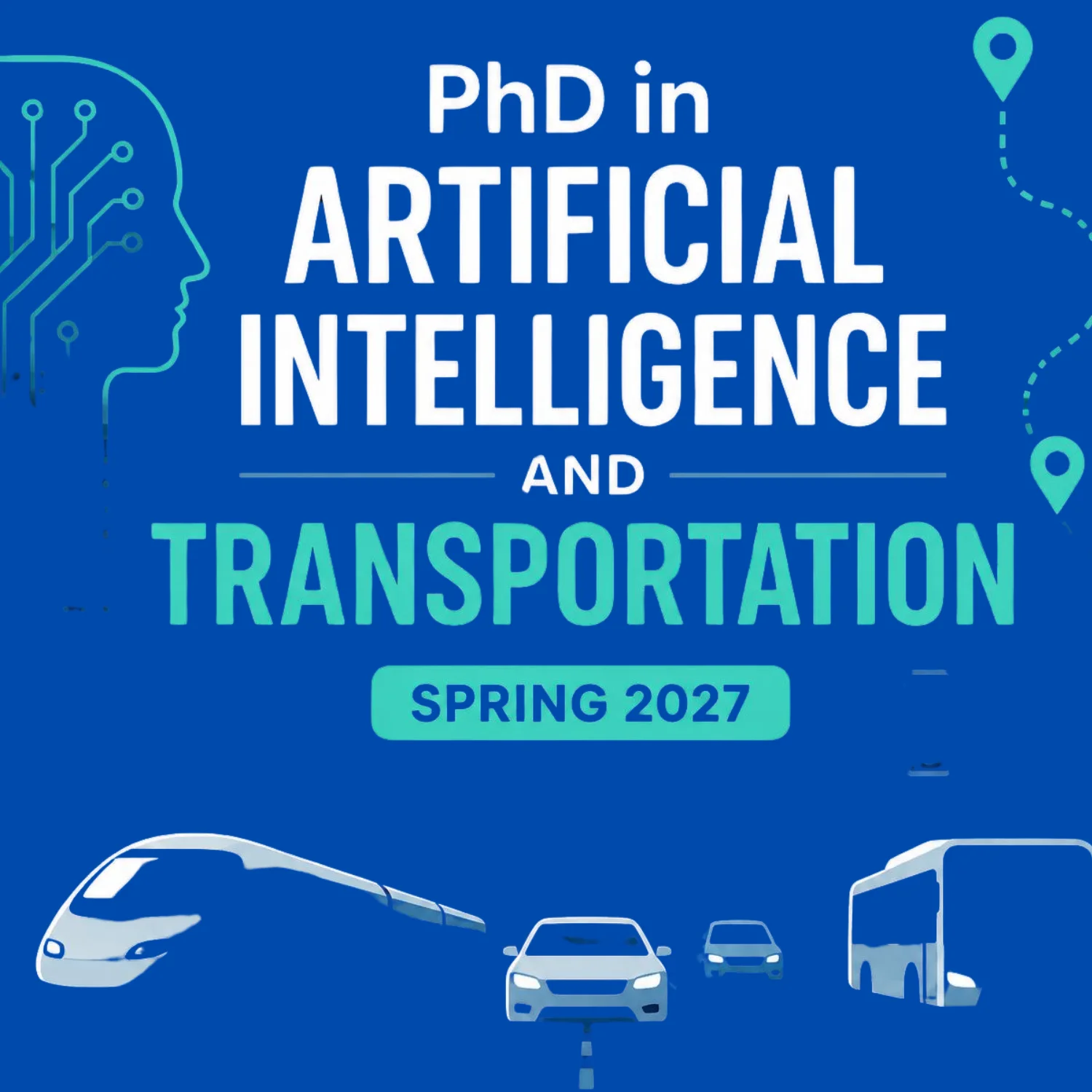
Texas State University is now calling for applications for PhD Doctoral Research Assistant (DRA) positions in the Artificial Intelligence in Transportation (AIT) Lab for the Spring 2027 intake. This position is ideal for those candidates who are motivated to engage in interdisciplinary research at the nexus of transportation engineering, traffic safety, data analysis, artificial intelligence, and digital solutions.
The selected candidate will be a member of the AIT Lab under the mentorship of Dr. Subasish Dey and conduct research that blends together transportation safety and operations along with contemporary techniques of AI, which include agentic AI, retrieval augmented generation, multi-agent systems, software development, and model assessment.
Candiates with backgrounds in civil engineering, computer science, computer science and engineering, or computer engineering are invited to apply.
About the PhD position
One PhD student is being sought by the Artificial Intelligence in Transportation Lab at Texas State University to start in Spring 2027 as a doctoral research assistant.
The lab is looking for a researcher who is capable of coming up with research concepts on their own, performing analysis, writing, and converting research findings into usable products. The job seems to be very much suitable for students whose areas of interest include intelligent transportation systems, road safety, analytics of mobility, AI-driven decision-making, traffic operations, and machine learning applications.
It is expected that the doctoral student recruited will work towards creating reproducible research, technical publications, software applications, web-based applications, APIs, and other research deliverables.
PhD in Artificial Intelligence and Transportation Research areas
The PhD candidate can pursue research in the area of transportation safety, traffic operations, artificial intelligence, and transportation systems using software.
Areas of interest might include:
- Traffic crashes, data analysis, and modeling of road safety.
- Evaluation of traffic safety countermeasures.
- Traffic management and performance evaluation of roads.
- Intelligent transport systems and data-enabled mobility solutions.
- Artificial intelligence for transportation planning and safety.
- Agentic AI solutions for research, analysis, and decision-making.
- RAG (retrieval-augmented generation) for transport information systems.
- Multi-agents AI workflows and AI models evaluation.
- Development of web apps, API, and transportation apps.
- Reproducible research and software development for civil engineering problems.
Such an opportunity would be particularly enticing to individuals who wish to employ the methodologies of machine learning and large language models in practical engineering scenarios as opposed to purely theorizing about AI applications.
Eligible academic backgrounds
Applicants who have obtained a Bachelor’s or Master’s degree in any one of the following streams could apply:
-
Civil Engineering
-
Computer Science
-
Computer Science and Engineering
-
Computer Engineering
Candidates in technical fields which are very closely related may also want to contact the supervisor when their experience aligns well with the research topics.
An excellent candidate will have both technical and research capability. Candidates need not have equal experience in all listed fields; however, they must have the capability to learn, be proactive, take initiative, and have genuine interest in research related to AI in transportation.
Desired qualifications and skills for PhD in Artificial Intelligence and Transportation
AIT Lab is seeking candidates with knowledge in various areas including transportation engineering, artificial intelligence, programming, research dissemination, and product development.
For candidates who have their background in machine learning, computer science, data science, or engineering, an application project related to RAG, LLM evaluations, AI agents, document searching, data analysis, or automation can be very appropriate.
Programming and computing skills for PhD in Artificial Intelligence and Transportation
Technical skills desired are:
- Python programming.
- Git and GitHub for version control.
- GitHub academic projects reproduction and extension.
- Coding help from AI powered by software engineering basics.
- Google Colab.
- Computing in Jupyter notebooks.
- Development with Docker containers.
- Computation on GPU.
- AWS – Amazon Web Services.
- Data processing, training, testing, and deployment of models.
Candidates need to be prepared to demonstrate practical coding experience as opposed to theoretical coursework. Having a well-documented GitHub, published work, technical report, code snippet, or portfolio is beneficial.
Admission requirements for PhD in Artificial Intelligence and Transportation
Candidates should satisfy the criteria for admission into the particular doctoral program in Civil Engineering offered by Texas State University.
The announcement shows the following requirements:
Applicants need to ensure that they confirm the current admission requirements for the programme from Texas State University prior to applying. Policies at universities may change, and therefore a supervisor’s call for applications does not override the admission requirements for graduate studies.
Application documents for PhD in Artificial Intelligence and Transportation
Candidates who are interested will need to do the following:
- Updated Curriculum Vitae or CV.
- GitHub page, website, or any other proof of coding and project experience.
- A piece of writing.
- Statement about research interests.
- Description of one completed project and the candidate’s role in it.
- Academic records, test scores, and other required application materials for the PhD program at Texas State University.
In describing projects, it is essential to clearly state:
- The problem that they were trying to solve.
- The data, method, model, or software approach that they used.
- How each one of them contributed to the solution.
- The findings of their work.
- A link to code, publication, demo, dashboard, report, or portfolio.
One way is by describing an AI project, such as creating a crash severity prediction model, developing a RAG assistant for transport documents, constructing a dashboard for traffic data, or implementing a Python API for analyzing road safety data.
How to apply for PhD in Artificial Intelligence and Transportation
Applications should be sent by email to:
Dr. Subasish Dey (Email: [email protected])
The applicant must attach his/her CV, link to GitHub or portfolio, writing sample, and a brief description of his/her research interests. One completed project and the applicant’s specific contribution in that regard should also be mentioned.
An appropriate subject line in the e-mail may read as follows:
Prospective PhD Applicant – Spring 2027 – AI in Transportation ResearchWhy PhD in Artificial Intelligence and Transportation is notable
What sets this doctoral program apart is its emphasis on three growing fields, transportation safety, artificial intelligence, and software engineering.
While many PhD programs tend to focus more on theory and modeling, this program places emphasis on the entire process of research development, from analyzing real world transportation issues, designing AI solutions, testing performance, documentation, software deployment and improving through user feedback.
That makes this doctorate program appealing for those who want to pursue a career in:
- Intelligent transportation systems.
- Research on transportation safety.
- Data science and artificial intelligence in public infrastructure.
- Machine learning applications.
- Civil engineering analysis.
- Artificial intelligence products.
- R&D in government, consulting, tech, or academia.
Important links for PhD in Artificial Intelligence and Transportation
-
Artificial Intelligence in Transportation Lab: Visit the lab page
-
Texas State University Civil Engineering PhD programme: Visit the programme page
-
Contact email: [email protected]
PhD in Artificial Intelligence and Transportation FAQ
Is this a funded PhD position?
The job description mentions the role of a Doctoral Research Assistant which is usually a research assistant. It is important for the applicant to clarify the funding, amount of stipend, tuition, insurance, period of appointment, and renewal policy with the supervisor of the university.
Can applicants from computer science apply?
Yes. It specifically mentions Computer Science, Computer Science & Engineering, and Computer Engineering as the eligible educational backgrounds. Candidates must demonstrate their AI/programming/software/data analysis skills that can be relevant for transportation research.
Is transportation-engineering experience mandatory for PhD in Artificial Intelligence and Transportation?
Transportation Safety and Operations is identified as one of the significant areas, although the recruitment advertisement also stresses the importance of agentic AI, Python, software development, web tools, APIs, and scientific communication. Candidates who come from computing field can also prove themselves fit for the position if they show the capability to work in transportation applications.
What should applicants include in a GitHub portfolio?
An impressive portfolio might contain readable code, description of the project, installation instructions, source of datasets when relevant, evaluation of models, screenshots or plots, instructions for reproducing work, and explanation of what the applicant did. Quality, clarity, and relevance are more important than having numerous incomplete repositories.
What kind of writing sample is appropriate?
Suitable pieces can include a thesis chapter, journal manuscript, conference paper, technical report, research proposal, capstone report, or analytical article. A sample that shows clarity, technical detail, evidence-based arguments, and organization would suffice.
Disclaimer
This article has been prepared for the purpose of providing information according to the PhD recruitment notice. The prospective candidates need to confirm all eligibility requirements, English language conditions, GRE guidelines, dates, and the application procedure through the official website of Texas State University.








Leave a Reply