

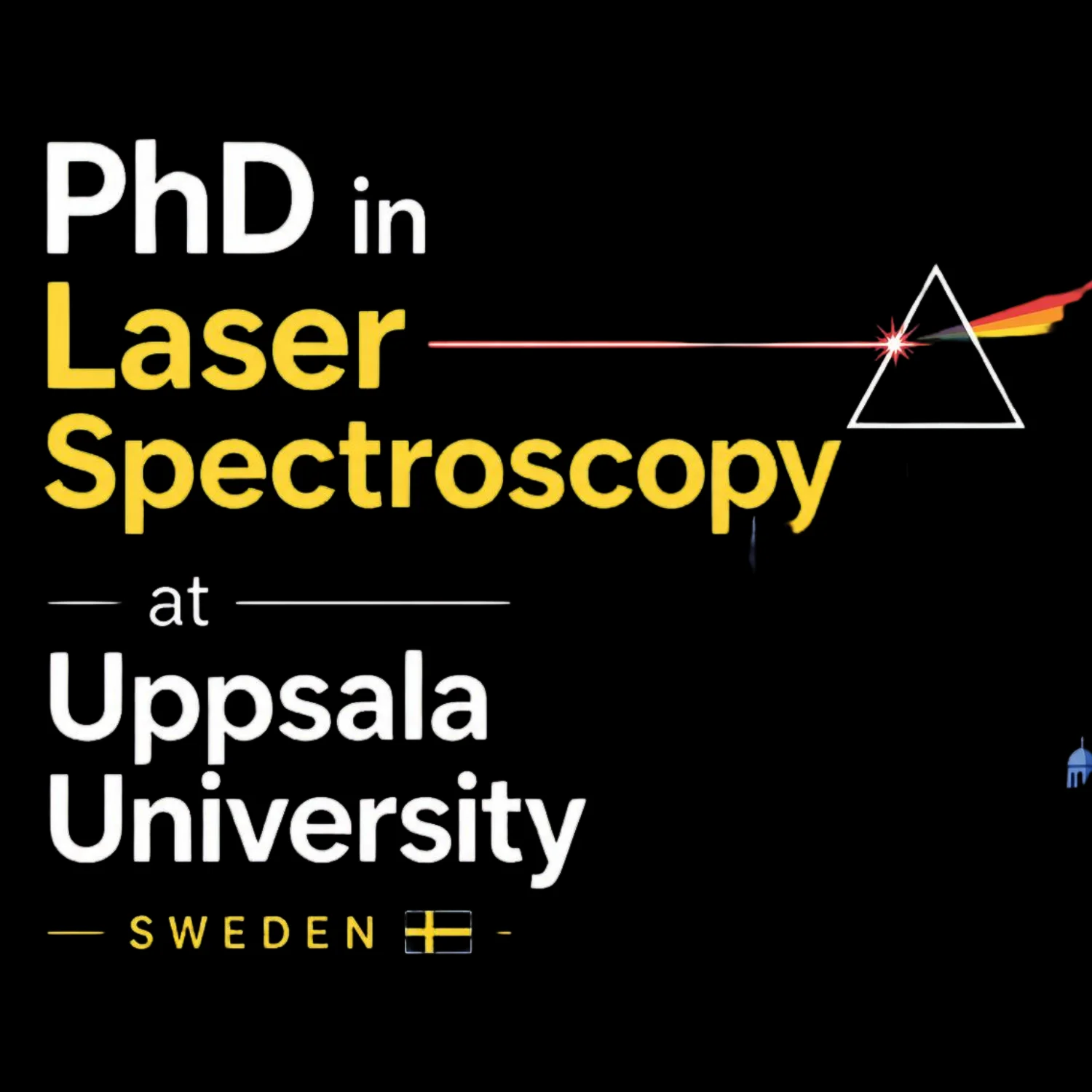
An opening for a PhD position in laser spectroscopy is available at Uppsala University, Faculty of Science and Technology, Department of Physics and Astronomy. This program suits candidates with experience in physics, chemistry, chemical physics, molecular science, or any related field who wish to study the charge dynamics involved in chemical reactions in liquids.
The selected candidate will use femtosecond THz and optical spectroscopy to elucidate the effect of the charge distribution of molecules on the chemical reaction process, especially for catalysis.
Laser Spectroscopy PhD Overview
The post will be situated at the HELIOS laser facility that belongs to the Department of X-ray Photon Science at Uppsala University. As a PhD student, you will be involved in the research environment where spectroscopic techniques using ultrashort pulses of THz, optical, and X-ray radiation are developed to investigate molecular charge dynamics.
Laser Spectroscopy Research Project
Chemical reactions are highly dependent on how electrical charge flows in and between the molecules. Even slight variations in molecular charges during catalytic reactions can affect the pathway, activation of bonds, reaction rates, and product formation.
The PhD research will concentrate on the study of such phenomena in chemical reactions of liquid phase through ultrafast spectroscopy. The research will involve the development and utilization of ultrafast THz and optical spectroscopy techniques to study how molecular charges change over very short periods.
One femtosecond is equal to 10−1510^{-15}10−15 seconds, which means a quadrillionth of a second. Various electronic and molecular phenomena, such as charge redistribution due to excitation and early stage chemical reactions, occur on the femtosecond scale. Thus, the use of femtosecond spectroscopy allows researchers to analyze chemical dynamics that would be impossible to investigate in any other way.
The candidate for the position will work on experiments aimed at solving such problems as:
- What is the effect on charge distribution in molecules during chemical reactions in solution?
- What is the impact of these ultrafast effects on chemical reactivity?
- How important are charge dynamics to catalysis?
- How can THz and optical spectroscopy techniques be used to understand reaction mechanisms in complex liquid phases?
- How can new ultrafast spectroscopy facilities advance research into chemical phenomena?
The research program links molecular physics at a fundamental level with chemical issues of importance, including catalysis, energy harvesting, and bond cleavage.
PhD in Electrocatalysis for Sustainable Energy Conversion (2026)
What the PhD Student Will Do
The chosen PhD student is intended to conduct experiments in femtosecond laser spectroscopy in the HELIOS laser lab. The position requires the combination of science-based instrumental skills, experimental work, data processing, and collaboration.
Responsibilities may involve:
- Conducting experiments in femtosecond laser spectroscopy.
- Enhancing capabilities of femtosecond THz and optical spectroscopy.
- Designing experiments on charge kinetics in chemical reactions in the liquid phase.
- Analyzing spectroscopic data to explore molecular charge distribution and reactivity.
- Working on catalytic and photochemical molecular processes.
- Collaborating with experimentalists and theorists.
- Preparing scientific articles for publication in peer-reviewed journals.
- Prestenting research results at internal meetings, workshops and international conferences.
This is very appealing to those who wish to have practical exposure to cutting-edge laser systems, as well as solid knowledge of physical chemistry, molecular physics, and spectroscopy.
Eligibility and Preferred Background
Applicants need to fulfill Uppsala University’s general eligibility criteria for doctoral education. The candidates are expected to have a Master’s degree, or an equivalent degree, in physics, chemistry, or a similar subject.
However, the applicant will also be eligible if they possess at least 240 higher education credits where 60 credits are at the master’s level, including an independent project amounting to at least 15 credits. Academic knowledge that is acquired through some other means could also be considered. Good language proficiency in English is a prerequisite.
This position would be particularly apt for those who have done academic research in the following fields:
- Physics, chemical physics, chemistry, molecular physics, or physical chemistry.
- Spectroscopy, laser technology, optics, photonics, or ultrafast technology.
- Molecular dynamics, electronic structure, or reaction dynamics.
- Experiment design, laboratory equipment, and data analysis in science.
- Catalysis, photochemistry, solution chemistry, or chemistry driven by light.
- Programming or numerical techniques for scientific data processing.
- Quantum chemistry or molecular simulation.
Molecular physics and spectroscopy knowledge and practical spectroscopic or instrument work will be a definite advantage. Quantum-chemical calculations experience can also be helpful but not absolutely necessary.
Why Apply for the PhD in Laser Spectroscopy?
It is an unusual chance to conduct research at the point where ultrafast optics, spectroscopy, molecular science, and chemistry intersect. The PhD student will not have just to use traditional methods but will contribute to building the infrastructure of femtosecond THz and optical spectroscopy.
The researcher will be able to acquire experience in:
- Working with femtosecond laser sources and ultrafast experimental methods.
- Examining electron and charge dynamics in chemically interesting systems.
- Exploring liquid-phase chemical reactions on their fundamental timescales.
- Developing, performing, and analyzing cutting-edge spectroscopic experiments.
- Cooperating in both experiment and theory.
- Publishing scientific papers and presenting results globally.
Those who wish to build their careers in the field of ultrafast science, spectroscopy, chemical physics, photonics, or instrumentation will find this position extremely beneficial for them.
How to Apply
The deadline for interested candidates to apply is 20 November 2026.
Interested candidates should refer to the official job description for detailed information on how to apply, documentation needed, eligibility conditions, and recruitment process. Standard requirements for applying for a PhD position at Uppsala University include a motivation letter, CV, transcripts of records, certificates, Master’s thesis or examples of scientific writing, and references. Candidates should check the official vacancy page for the exact list of documents. uuu+2
Application deadline: 20 November 2026
Position: PhD Student in Laser Spectroscopy
Location: Uppsala, Sweden
Reference number: UFV-PA 2026/2816
Candidates can apply via the official recruitment portal of Uppsala University:
APPLY HEREClick here for more information
Final Thoughts
The PhD position of Laser Spectroscopy at Uppsala University is an excellent chance for students willing to investigate the fundamental molecular processes responsible for the chemical reactivity. Combining the use of femtosecond THz and optical spectroscopy along with studying reactions in the liquid phase and catalysis, the research provides both great experimental experience and scientific depth.
Applicants holding a master’s degree in physics, chemistry, or a related discipline and showing an interest in ultrafast spectroscopy, molecular charge dynamics, and chemical reactions are welcome to apply until 20 November 2026.
Frequently Asked Questions
What is the PhD position in laser spectroscopy at Uppsala University?
This is a full-time doctoral-level research project position at the Department of Physics and Astronomy, Uppsala University, Sweden. This project involves the use of femtosecond THz and optical spectroscopy for the study of charge dynamics in liquid-phase chemistry, with an emphasis on the importance of molecular charge distribution for catalysis. This work will be carried out in the HELIOS laser laboratory, which is managed by the Division of X-ray Photon Science.
When is the application deadline?
The deadline for submitting the application is 20th November 2026. The applicants should send their application along with all relevant documents using the recruitment portal of Uppsala University.
When will the PhD position begin?
The anticipated commencement date is 1 February 2027, but the commencement date can be agreed upon with the selected individual.
Where is the PhD position based?
This position will be located in the Department of Physics and Astronomy at Uppsala University in Uppsala, Sweden. The Ph.D. student will be working at the HELIOS Laser Laboratory at the Division of X-ray Physics.
Which academic backgrounds are suitable?
The ideal candidate should possess master’s-level expertise in physics, chemistry, chemical physics, molecular physics, physical chemistry, or some other related field. Candidates with an excellent grasp of molecular science, spectroscopy, chemical processes, optics, and experimental physics could be especially well-suited for this position.
Is a master’s degree required?
The applicants must fulfill the entrance criteria to pursue a doctoral program at Uppsala University. The usual criteria here would mean having a second-level education, either a Master’s Degree, or completing a minimum of 240 higher education credits that include 60 credits at Master’s level along with an independent project of 15 credits.
Do I need prior laser spectroscopy experience?
Having prior practical experience in laser spectroscopy and/or scientific instrumentation would be an advantage, since the project deals with femtosecond THz and optical spectroscopy measurements. However, it is recommended that all candidates review the official job announcement in order to find out what the essential qualifications are and what the preferred qualifications are.
Is experience in quantum chemistry or molecular simulations required?
Quantum-chemical simulation experience is an asset; however, it should not be considered a necessity. Candidates who have a theoretical, computational, or modelling background might find that such background complements the experimental nature of the project.
What is femtosecond THz and optical spectroscopy?
Femtosecond spectroscopy employs very short laser pulses that allow us to probe processes that happen on the 10^{-15} second timescale. In this particular project, we will use THz and optical approaches to understand how charge distributions of molecules are modified during liquid-phase chemical transformations and how these changes impact the reaction efficiency. In general, the group explores ultrashort THz, optical, and X-ray approaches to studying charge dynamics in molecular processes related to catalysis and light harvesting.
What research topics will the PhD student investigate?
This project seeks to understand ultrafast charge dynamics in liquid-phase chemical reactions. Its key scientific question is “How does molecular charge distribution affect chemical reactivity?” The project has the potential to relate molecular charge dynamics to chemical processes like bond breaking and light harvesting.
What will the selected PhD student do?
Femtosecond laser spectroscopy experiments will be carried out by the PhD candidate. She will also assist in the development of spectroscopic instrumentation for THz and optical spectroscopy. She will engage in experimental design and analysis and study the charge distributions in molecules during chemical reactions.
Is the PhD in Laser Spectroscopy fully funded?
The job opening is presented as being that of a full-time doctoral employment opportunity, not as a PhD program without funding. However, candidates are encouraged to look at the official job description for more up-to-date details regarding pay, terms of funding, benefits, and the period of employment.
Is a PhD in Laser Spectroscopy suitable for international applicants?
Certainly. This vacancy notice is advertised in English, and the candidates are expected to have good proficiency both in writing and speaking the English language. The foreign candidates who qualify academically should read the notice carefully and fill out the online application form.
What documents should I prepare for the PhD in Laser Spectroscopy?
Applicants are required to submit the required documents according to the guidelines specified by the official recruitment website. In the case of Ph.D. applications, applicants are usually required to submit a curriculum vitae, certificates, transcripts, a cover letter or research interests statement, and additional documents relevant to their Master’s thesis or academics.








nip
That was amazing