

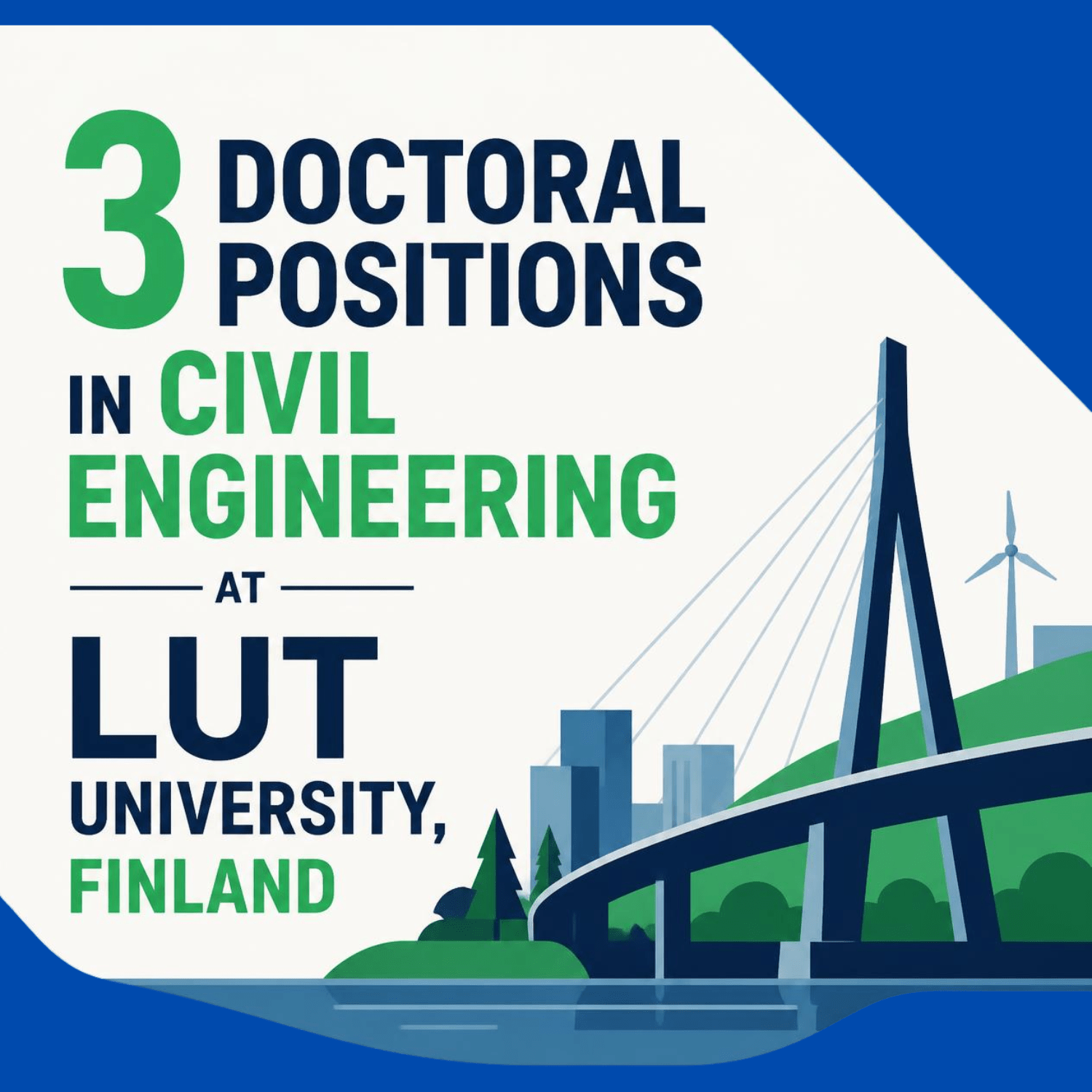
Apply for 3 doctoral positions at LUT University in Finland, with research in thermal management, AI energy systems, and district heating. Three doctoral researcher vacancies are being advertised by LUT University in its expanding civil engineering group in Lahti, Finland. The positions will provide the researcher with the chance to undertake relevant research in the fields of sustainable built environment, advanced cooling technology, data center energy systems, building energy flexibility, thermal comfort, and district heating systems.
There are three PhD research openings in the following areas: Advanced Thermal Management & Heat Transfer Technologies, AI Infrastructure & Energy Systems, and Occupant-Centered Heating Control and District Heating. The deadline for applications is 4 October 2026.
Doctoral Opportunity at a glance
About the Doctoral positions
The doctoral researchers will be part of the Civil Engineering unit at LUT University in Lahti and research key issues relating to energy and sustainability in the built environment.
There is growing connectivity among modern buildings, energy systems for urban areas, digital systems, and cooling systems. Issues relating to increasing digitalization, data center capacity, cooling due to climate, and decarbonizing heating systems are creating new challenges for research. Therefore, these research projects seek to address such issues scientifically to help improve energy efficiency, lessen environmental impact, ensure comfort of occupants, and increase the sustainability of buildings of the future.
The selected researchers will undertake research on topics involving advanced cooling systems, energy consumption in data centers, intelligent heating, thermal comfort, energy flexibility of buildings, and district heating systems.
Doctoral Research area 1: Advanced Thermal Management and Heat Transfer Technologies
The first doctoral research field concerns high-level thermal management and heat transfer systems. This field is applicable to the design, analysis, optimization, and control of systems related to transferring, storing, or dissipating thermal energy efficiently.
Thermal management is becoming more and more crucial in buildings, industrial operations, electronics, transport applications, and energy production systems. Thermal management systems may assist in lowering the level of energy use and enhancing the effectiveness of equipment.
Possible topics for research may include:
- Cooling systems for buildings and infrastructure
- Heat transfer and optimization of thermal systems
- Energy-efficient cooling systems
- Management of thermal energy for sustainability in the built environment
- Renewable energy and thermal energy storage integration
- Modeling and simulation of heat transfer
- Low-carbon heating and cooling systems
Such a role will be suited to candidates having experience with mechanical engineering, energy engineering, civil engineering, building services engineering, thermodynamics, HVAC engineering, heat transfer, or thermal energy systems.
Candidates with skills in computational modeling, numerical simulation, experimental thermal analysis, CFD, MATLAB, Python, EnergyPlus, TRNSYS, Modelica, or similar software could be very well suited for such research.
Doctoral Research Area 2: AI Infrastructure and Energy Systems
The second doctoral research position concerns AI infrastructure and energy systems, an emergent interdisciplinary field that relates artificial intelligence, digital infrastructure, data centers, cooling, and energy system sustainability.
AI applications involve heavy use of computing power, leading to the growing importance of sustainable data centers and digital infrastructures. Computing centers consume a lot of energy, both for cooling and for servers, air conditioning, ventilation, and energy systems management.
In this doctoral research, the researcher will probably look into how AI infrastructure could be designed and run more sustainably. This will probably include investigation into the energy use of data centres, innovative cooling systems, waste heat utilization, renewable energy, energy system flexibility, and infrastructure optimization.
Research areas can include:
- Data center energy-efficient infrastructure
- Cooling technologies for HPC systems
- AI electricity requirements and energy system considerations
- Heat recovery from computing facilities
- Data center integration with district heating systems
- Renewable energy integration into digital infrastructure
- Optimizing energy systems using predictive control
- Low-carbon digitalization and sustainable computing
This opportunity could be valuable for students who graduated from fields such as energy engineering, mechanical engineering, electrical engineering, civil engineering, computer science, environmental engineering, applied physics, or any other related field.
Students with experience in energy modeling, machine learning, optimization, data analysis, building energy analysis, thermal systems, or renewable energy systems could have a strong background in this field.
Doctoral Research area 3: Occupant-Centric Heating Control and District Heating
The third doctoral area is related to occupant-based heating control and district heating. This topic involves building energy performance, occupant comfort, intelligent control systems, demand management, and urban energy networks.
Currently used traditional building heating systems are usually controlled by predefined schedules or temperatures. However, different occupants have various comfort requirements, work routines, and occupancy behaviors. The goal of occupant-based heating is to achieve a higher level of responsiveness and decrease unnecessary energy consumption.
The research may also cover the interaction of individual buildings with district heating networks. By improving the flexibility of building energy use, the shifting of demand, peak load reduction, the integration of renewable energy resources, and the improvement of urban energy network efficiency may be achieved.
Directions for possible research are:
- Smart and adaptive heating control
- Occupant-oriented thermal comfort models
- Building energy flexibility
- Demand-side management for heating
- District heating optimization
- Building intelligent energy management
- Integrating buildings with low-carbon heat networks
- Energy storage for heating
- Thermal energy storage and load shifting
- Building system digital twins and control
This PhD position will most likely suit those who have expertise in the field of building physics, HVAC systems engineering, civil engineering, energy engineering, smart buildings, urban energy systems, thermal comfort, control engineering, district heating, and data-driven modelling of buildings.
Why this doctoral research matters
Buildings, heating, cooling, and digital infrastructure will all be key in making the shift towards sustainable energy systems.
Heating and cooling constitute a large part of energy use in many parts of the world, and both urbanization and climate change are putting strain on buildings and infrastructure. Meanwhile, AI and digital services are rapidly developing, which means that there is an increasing need for data centers and computationally intensive services.
Thermal management, sustainable heating, flexible buildings, and sustainable data center operations can help solve these issues. Doctoral studies offered by LUT University give an opportunity to work towards the solution of these problems through innovation and sustainability.
The research themes also connect strongly with several global priorities:
- Reducing energy use and GHG emissions
- Increasing energy security and resilience of infrastructure
- Increased integration of renewables
- Increased thermal comfort and indoor environment quality
- Building smart and flexible buildings
- Improved sustainability of AI and data centers
- Low-carbon cities and district heating
Who should consider applying for the doctoral position?
Such Ph.D. researcher positions could well suit candidates who have completed a master’s program or similar qualification in a related engineering, energy, environmental, or technological area.
Such potentially appropriate educational fields include:
- Civil Engineering
- Mechanical Engineering
- Energy Engineering
- Building Services Engineering
- Heating, Ventilation, and Air Conditioning Engineering
- Environmental Engineering
- Electrical Engineering
- Chemical Engineering
- Applied Physics
- Architecture and Building Physics
- Computer Science / Artificial Intelligence
- Sustainable Energy Systems
- Urban Energy and Infrastructure Planning
The applicants are advised to go through the complete job notice issued by LUT University for more details regarding the qualifications and other relevant information.
Skills that may be valuable
Even though the exact qualifications can be determined by consulting the official vacancy posting, the following qualifications might prove to be beneficial for the candidate based on the chosen field of study:
- Heat transfer and thermodynamics
- HVAC systems and building energy engineering
- Building energy modeling and simulation
- Cooling of data centers and energy analysis
- District heating
- Thermal comfort and IEQ
- Modelling and optimization of energy systems
- Artificial intelligence and machine learning
- Predictive control and intelligent buildings
- MATLAB, Python, R, or other software
- CFD and simulation
- Experimentation and data analysis
- Scientific writing and publications
It is not necessary that a candidate must have experience in all fields. Nevertheless, a candidate should effectively communicate how his education, thesis, research, technical work, or professional experience connects with the intended doctoral project.
How to prepare a strong application for the doctoral position?
Prior to applying, it is recommended that candidates peruse the official job description and ensure that all documents are geared toward the specific research theme.
An effective application will demonstrate:
-
Academic preparation
Describe how your degree program, courses, research project, lab experience, modeling experience, or master’s thesis has prepared you to conduct doctoral-level research. -
Technical relevance
Directly link your technical skills with what is advertised. For instance, candidates applying for the position in thermal management could mention their expertise in heat transfer, thermodynamics, cooling, CFD, and thermal modeling. -
Research motivation
Identify why the chosen research area is important to you and how you plan on contributing to sustainable buildings, energy systems, district heating and cooling, or digital infrastructure.
As another example, the application letter for the AI Infrastructure and Energy Systems role could include:
From experience with modelling and analysis of data associated with energy, my interest in sustainable digital infrastructure has been formed. My motivation is to explore ways of reducing environmental effects of energy usage in data centres and AI computations through efficient cooling and thermal management solutions.
The applicants have to tailor such a statement to match their actual academic experience and interests.
Doctoral Position Required Documents
The official vacancy notice at LUT University is considered the ultimate source of information concerning application requirements. However, some of the items that may be requested of doctoral researcher applications include:
- Curriculum vitae
- Letter of motivation or cover letter
- Certificate of degree
- Transcripts
- Master’s thesis or master’s thesis summary
- Publication list, conference presentation, or other research output list
- Technical or research project portfolio
- Referee contact information
- English language test proof, where needed
All applications must make sure to include everything properly completed and labeled in a professional manner by the deadline.
Important deadline for the doctoral position
The application deadline for these PhD researcher positions is:
4 October 2026 at 23:59 Finnish local time (UTC+3)
The recruiter will also be available to answer questions by email and phone on:
21 September 2026, from 14:00 to 16:00 Finnish time (UTC+3)
The relevant time for Malaysian applicants will be between 19:00 and 21:00 Malaysian time (UTC +8) on 21st September 2026. Based on the mentioned time zone (UTC+3) of the announcement, the deadline for applications will be 04:59 Malaysian time (UTC+8) on 5th October 2026.
Prospective applicants are advised to formulate their questions beforehand and get in touch with the recruiter during his/her availability to clarify the issues related to project scope, required qualifications, supervision, research atmosphere, etc.
How to apply for the doctoral position
Prospective candidates are encouraged to access the relevant website, go through the complete notice for the doctoral researcher position, and apply to the LUT University recruitment system.
Since requirements can change or be further explained on the recruitment page, applicants need to check the following before applying:
- The title for the doctoral researcher position
- The field of interest
- Eligibility requirements for applicants
- Application materials required
- Conditions of employment and funding
- Language requirements
- The application website
- Final deadline and time zone
Final thoughts on the 3 doctoral position
The three PhD research positions available at LUT University provide an excellent chance for young researchers who have interests in sustainable buildings, thermal engineering, energy systems, AI infrastructure, and district heating.
In particular, candidates looking to pursue their PhD studies in Finland would be highly encouraged to apply, as the projects have a great combination of engineering applications along with interesting research fields that are growing rapidly across the globe, namely energy-efficient cooling and heating, smart buildings, flexible energy systems, sustainable data centers, and occupant comfort.
Interested candidates having research focus on civil engineering, mechanical engineering, energy engineering, building technology, or data-enabled energy systems can consider applying until 4 October 2026.
Frequently Asked Questions
1. How many doctoral researcher positions are available at LUT University?
Three doctorate students are being sought after by LUT University to fill their positions at the Civil Engineering group in Lahti, Finland. The possible research topics are Advanced Thermal Management and Heat Transfer Technology, AI Infrastructure and Energy Systems, and Occupant-Centric Heating Control & District Heating.
2. Where are the PhD positions located?
These doctoral researcher positions are located at LUT University in Lahti, Finland. Interested candidates can refer to the vacancy notice to get details regarding work arrangements, opportunities for teleworking, and residence conditions.
3. What research areas are covered by these PhD positions?
Positions include the following three research topics:
- Thermal Management Technologies & Heat Transfer Technologies
- AI Energy Infrastructure Technologies
- Heating Control by Occupants & District Heating
The projects involve advanced cooling technology, energy systems for data centers, energy flexibility in buildings, thermal comfort, sustainable heating, and low-carbon built environments.
4. What is the application deadline?
Deadline: 4 October 2026, 23:59 Finnish local time (UTC+3).
It would be best not to delay submitting your application until the last minute because online systems might become overcrowded, and you will need time to compile necessary documents.
5. Who can apply for these 3 doctoral positions?
This may apply to candidates having a master’s degree or equivalent in one of the following areas: civil engineering, mechanical engineering, energy engineering, building services engineering, environmental engineering, electrical engineering, applied physics, architecture and building physics, computer science, or similar subjects.
The actual eligibility requirements from the academic background side can be verified in the LUT University recruitment announcement.
6. Is this opportunity suitable for international applicants?
International applicants can also be eligible to apply, depending on the particular requirements stated in the official job advertisement and LUT University’s doctoral studies regulations.
Applicants need to ascertain their academic eligibility, English language proficiency, conditions of employment, residence permit requirements, and documentation in individual countries, where applicable.
7. Are the 3 doctoral positions funded?
The announcement refers to the chances as positions for doctoral researchers. In Finland, the positions of doctoral researchers are usually arranged as paid jobs, but the candidates should not make any assumptions regarding the pay, financing period, tuition, health insurance, or terms of employment without checking the vacancy page of LUT University.
8. What background is useful for the Advanced Thermal Management and Heat Transfer position?
These research topics might be appropriate for those who have a background in:
- Transfer of heat and thermodynamics
- Thermal management and cooling technologies
- Heating, ventilation, and air conditioning (HVAC)
- Energy-efficient buildings
- Thermal energy storage
- Computational fluid dynamics
- Numerical simulation
- Thermal characterization experiments
Candidates are expected to describe how their academic background, master’s dissertation, research exposure, or technical projects relate to thermal systems and sustainable energy applications.
9. What background is useful for the AI Infrastructure and Energy Systems position?
The role might be of interest to those who want to work on the connection between AI computation, data centers, cooling facilities, and energy consumption.
Valuable experience can consist of:
- Energy analysis in the data centre
- Modelling of energy systems
- Cooling systems
- Machine learning/data analytics
- Modelling and optimisation
- Renewable energy incorporation
- Waste heat recovery
- Smart grids/flexible energy systems
The candidates need not necessarily be an expert in all these areas. What is essential for a good application is the candidate’s interest in sustainable digital infrastructures and his/her capacity to acquire the necessary skills.
10. What background is useful for the Occupant-Centric Heating Control and District Heating position?
This field of research may be useful to candidates with knowledge or an interest in:
- Building energy models
- HVAC and heating systems
- Thermal comfort
- Smart building technology
- Demand-side management
- Building energy flexibility
- District heating networks
- Control systems and optimization
- Urban energy systems
Prospective candidates could enhance their candidacy by showing that they know how smart heating control can lower energy consumption without compromising the occupant’s comfort.
11. Do I need prior experience in artificial intelligence for the 3 doctoral positions?
Not necessarily. While machine learning, programming, optimization, and/or data analytics may be useful for the AI infrastructure and energy systems, it is still necessary to check the official vacancy description for any must-have qualifications.
Those candidates who have experience in energy engineering, thermal management, data centers, building energy, or systems modeling will also be well-prepared, provided that they show their willingness to learn about AI research.
12. What documents should I prepare for the 3 doctoral positions?
Applicants should use LUT University guidelines. Common requirements for applications from PhD researchers include:
- Curriculum vitae
- Cover letter
- Master’s degree and bachelor’s degree diplomas
- Transcripts
- Master’s thesis, summary, or abstract of the thesis
- Publication list or list of research output
- Referees’ contact information
- Results of English language tests, where applicable
Do not submit documents unless they are required via the application website.
13. How should I write the motivation letter for the 3 doctoral positions?
The motivation letter must be addressed to one of the three areas of research. It should describe shortly:
- Academic background/degree relevant to your application
- Master’s thesis, research, work, or technical project experience
- Theme of research you are applying for
- What do you think you could bring to the project in terms of competencies
- Why would you be interested in doctoral studies at LUT University
- Your research/career plans
Do not apply for every PhD program you come across with the same motivation letter. You need to customize your letter according to the specific topic being advertised.
14. Can I apply for more than one research area out of the 3 doctoral positions?
It is advisable for applicants to go through the official job posting to ascertain whether a single application form is acceptable for all research areas or several application forms are needed.
In case more than one choice is allowed within the application process, clearly indicate your first choice of research area and how you qualify for the other choices you make.
15. When can applicants ask questions about the 3 doctoral positions?
The recruiter will be contactable by email and telephone between 14:00 and 16:00 Helsinki time (UTC+3) on 21 September 2026.
In the case of candidates residing in Malaysia, this corresponds to 19:00 to 21:00 on 21 September 2026.
Prepare targeted questions concerning the scope of the project, methodology, research team, supervision, prerequisites, employment terms, or the application process
16. How can I apply for the 3 doctoral positions?
The candidates need to visit the official opportunity page and then submit their application via the official LUT University recruitment portal within the stipulated time frame.
Please use the following official link to apply for the opportunity:
Read the doctoral researcher vacancy and apply
17. Should I contact the supervisor before applying for the 3 doctoral positions?
When there is provision for communication in the notice, it is better to make use of the contact details, particularly if you have any specific question that cannot be answered by referring to the vacancy notice.
Prior to making contact, study the entire notice. Do not ask questions that have been answered clearly in the notice itself. It is best to send a concise note stating your background and asking for answers to one or two questions.



Leave a Reply