

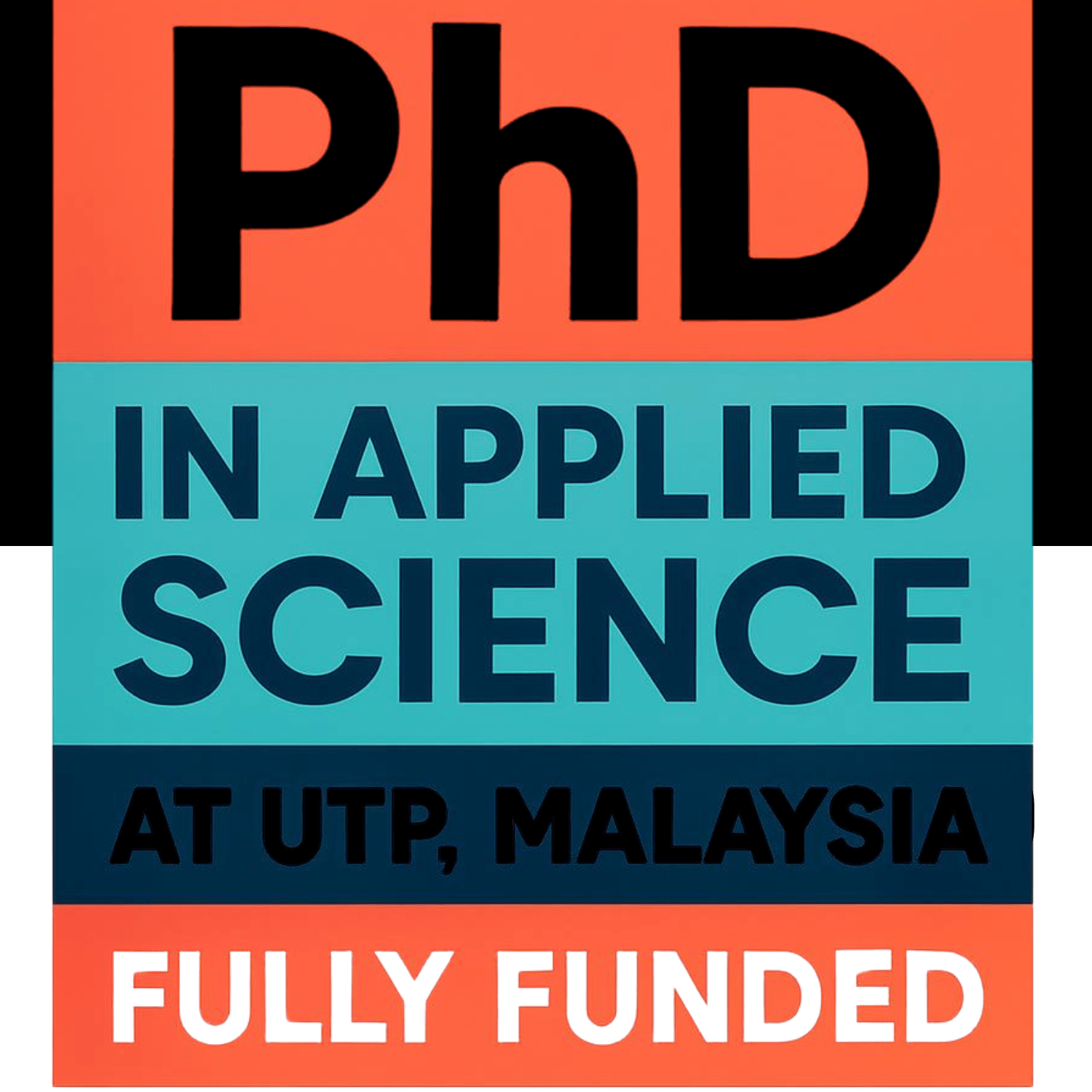
Are you a graduate in statistics or applied mathematics searching for an entirely sponsored PhD position in Malaysia? Universiti Teknologi PETRONAS (UTP) is offering the position of PhD in Applied Science with a specialization in statistical modeling, machine learning, and physics-inspired AI. This PhD will include monthly allowance of RM 3,000 along with complete waiver of tuition fees for candidates who act as teaching assistants (TA).
Remember: You need to apply before 31 May 2026; less than two weeks remain! In case you have publication(s) in Q1/Q2 journal and excellent quantitative skills, then you can make use of this chance to do PhD in applied science from a renowned Malaysian technological university.
Quick Facts About This PhD Opportunity
About Universiti Teknologi PETRONAS (UTP)
Universiti Teknologi PETRONAS is a privately owned research institution based in Seri Iskandar, Perak, Malaysia. Founded in 1997, UTP has become one of the best universities in Malaysia that offers courses in engineering, science, and technology. The university has been noted for its collaborations with industries, specifically with PETRONAS, the Malaysian national oil company, and its emphasis on conducting applied research.
The university has several doctoral programs in a variety of fields. In the case of the doctoral program in applied science, it is provided by the Department of Fundamental and Applied Sciences. The postgraduate programs at UTP have become very popular among students in Malaysia and other countries in Southeast Asia.
The location of the university in Seri Iskandar has made it possible to offer a more concentrated educational environment that is not influenced by big cities such as Kuala Lumpur, but still has all the facilities needed by the technological university.
PhD Programme Overview: Applied Science at UTP
The PhD program in applied science from the University of Technology of Pérouse (UTP) targets those who wish to conduct higher-level research in modeling, using techniques that are driven by data and based on physics. The PhD degree is awarded after 36 to 96 months of full-time studies according to the program timeline, with three intakes per year: January, May, and September.
The specific position is placed right at the crossroads of statistics, machine learning, and computational modeling. An excellent opportunity for those who wish to explore innovative questions combining theoretical knowledge and AI practice.
Research Focus Areas for This Position
The research focus areas:
- Statistics and Data Analytics – Creation of new statistical models and methodologies for working with large datasets and finding hidden patterns.
- Time Series Modeling – Construction of predictive models that analyze data points obtained through time.
- Multitask Neural Networks – Creation of neural networks that can learn several interconnected processes at once.
- Physics-Informed Neural Networks (PINNs) – Introduction of physical laws to neural network training to ensure that the resulting AI models work according to natural laws of physics.
These research topics are highly pertinent to modern developments in artificial intelligence and scientific computation. If you have background knowledge or interest in these fields, then you will find yourself in an excellent position to make contributions to this PhD program.
Funding Package: What You’ll Receive
One of the most attractive features of this opportunity would be the full funding offered by the program. The following benefits will be provided to the accepted candidates:
Monthly Stipend: RM 3,000
The program provides you with RM 3,000 per month throughout your PhD course. For international audience it means:
- Approximately USD 630-650
- Approximately EUR 600-620
- Approximately NGN 1,050,000-1,100,000
Even though this amount may look rather modest in comparison to PhD scholarships in America or Britain, it is important to consider the country of study – Malaysia. The cost of living in Malaysia is relatively low comparing to such cities as Kuala Lumpur, Klang or Georgetown. In the Seri Iskandar, Perak region where you will have to live as a student, RM 3,000 would be sufficient to cover the following needs:
- Rent (for a shared flat)
- Food
- Transportation
- Water, electricity bills and Internet
- Books and leisure activities
Tuition Fee Waiver
The programme will give a total waiver of tuition fees to those who accept responsibility as teaching assistants. This is a common practice in most doctoral programmes and usually entails:
- Helping out lecturers with undergrad courses
- Running tutorials or laboratory classes
- Marking and helping students out
- Working 10-15 hours per week doing teaching duties
The stipend and the tuition waiver ensure that you do not have any worry about the cost of the programme or having student loans to pay back.
Eligibility Requirements: Can You Apply?
There are certain qualifications for this particular PhD position which are mandatory. Applicants must go through these qualifications before proceeding with their applications.
Mandatory Requirements (All must be met)
1. Academic Qualification
- An undergraduate degree (BSc) or a postgraduate degree (MSc) in Statistics or Applied Mathematics
- The degree should come from an accredited institution offering courses with high emphasis on quantity
2. Minimum CGPA Requirement: 3.25
- In case you are applying based on a different grading system, it should be converted to a 4.0 grade point average
- If your academic system involves percentage, then 3.25/4.0 will translate into roughly 81-82%
- Equivalent grades in UK classification will be Upper Second Class Honours (2:1) or higher
3. ISI-Indexed Q1/Q2 Publications Requirement (Compulsory)
- It could be seen as the most stringent criteria
- At least one peer reviewed publication in a Web of Science (ISI) indexed journal
- The journals should be ranked either in the first or second quartile within its discipline
- These publications could emanate from either your undergraduate, masters, or individual studies
- You may use the Web of Science Journal Citation Report (JCR) to find quartile information
4. Sound Knowledge of Statistics, Mathematics Modeling, and Optimization
- Proven through courses, assignments, and research work
- Knowledge of inference statistics, hypothesis testing, regressions, and probability
- Awareness of optimization and numerical approaches
5. Good Python Coding Skills
- Python is the language used in all data science and machine learning researches
- Proficient in using NumPy, Pandas, Matplotlib, and SciPy libraries
- Knowledge in machine learning frameworks (scikit-learn, TensorFlow, PyTorch) is an advantage
6. Proven Research Skills and Ability to Work Independently
- Proved by your thesis work or scientific articles
- Ability to generate hypotheses, conduct experiments and get conclusions
- Self-motivation and time-management are necessary for a PhD degree
Preferred Qualifications (Added Advantage)
Having the following qualities, although not necessarily mandatory, would be helpful in making your application stronger:
- Interest or experience in deep learning – Knowledge on how to construct neural networks and train them as well as their applications
- Knowledge or experience in time series modelling – Knowledge on ARIMA, state space models or time series forecasting
- Knowledge on physics-based modelling – Ability to incorporate physical principles into computational models
Include such research work in your application if you have done any previously.
Who Should Apply? Target Candidate Profile
As per the requirements and the focus of research, the ideal candidates for the PhD in applied science:
- Statistics & Applied Mathematics Graduates with Previous Research Publication
You are one such candidate if you have pursued a master’s degree in statistics, applied mathematics, computational mathematics or any other related area, and have managed to publish papers based on your research in the process. It indicates that you possess sufficient expertise in quantitative research.
- Early Career Academics with Interest in AI & Machine Learning
Maybe you have been involved in data science, machine learning, statistical modeling, and similar fields for 1-3 years and wish to further your knowledge base by pursuing PhD. Also, if you have managed to get some of your papers published in the above course of time, here is an excellent chance for you.
- Students Pursuing Research Master’s with Publications
Are you a current research-based master’s student or graduate who has submitted or published your papers in Q1 and Q2-ranked journals? This is an excellent opportunity for you because such candidates are preferred in this program.
- Malaysian Candidates or Malaysia based International Candidates (Priority)
According to the opportunity advertisement, there is a preference for Malaysian candidates or international candidates based in Malaysia. As such, if you are currently in Malaysia pursuing studies on either a student visa or work permit, your application will be highly preferred than other applicants who are in another country.
However, this does not imply that international applicants who are currently out of Malaysia cannot participate in this program.
PhD in Applied Science Requirements
PhD in applied science applications like this one generally ask for the following documents:
1. Academic Curriculum Vitae (CV)
- Construct a CV which will include:
- Academic credentials with CGPA mentioned
- Your research experience along with the methodology employed
- A list of your publications (along with citations, journal names and quartiles)
- Your programming skills and software knowledge
- Teaching experience (if any)
- Honors, awards, or scholarships received
- Coursework in Statistics, Mathematics, Machine Learning
2. Academic Transcripts
- Academic transcripts from all universities attended
- Make sure that your CGPA is easily readable
- In case your transcripts are not written in English, submit their certified translations
3. Degree Certificates
- Photocopies of your bachelor’s and master’s degree certificates
In case you are completing your master’s program at the moment, attach a letter stating the exact date of graduation
4. Publication Records
- Published papers with full-text PDFs
- Journal indexing proof (screen capture from Web of Science – indicating Q1/Q2)
- For those papers which are currently under peer-review process and/or accepted for publication in journal but not yet published, please attach submission confirmation
5. Research Proposal or Research Idea
The poster states that participants should “share your research idea via application.” Write a brief research idea (500 – 1000 words) that:
- Describes the problem area for your research in one of four research areas
- States the importance of the problem and the research gap that exists
- Describes your approach or methodology
- Shows connection to statistical modeling, machine learning, physics-informed AI
6. Letters of Recommendation (Usually Mandatory)
PhD programs will usually ask you to submit 2-3 recommendation letters by:
- Your master’s thesis adviser
- Collaborators/Co-author(s) from research work
- Faculty who can assess your skills in quantitative analysis
Remember that the deadline is short and get in touch with your referees early.
7. English Language Requirements (If Necessary)
International candidates who have undertaken their previous study in non-English medium should have:
- IELTS (usually 6.0-6.5)
- TOEFL-iBT (usually 79-90)
Consult Dr. Yaman Hamed whether English language proficiency is mandatory in your case.
Fully Funded PhD in Agricultural Robotics at UGA – Apply Now
How to Apply for PhD in Applied Science
Step 1: Check Your Eligibility
Before submitting your application, make sure to go through all necessary criteria. Focus specifically on:
- CGPA requirement (should be 3.25 or more)
- Publication record (should contain at least one paper in Q1 or Q2 journals)
- Field of study (must be in Statistics or Applied Mathematics)
If any of these criteria are not met, then your application will likely not be considered.
Step 2: Collect All Required Documents
Collect all the required documents as mentioned above in a separate digital file as follows:
- Academic_Documents
- Publications (in PDF, along with their indexing proof)
- Curriculum Vitae and Research Proposal
- Letters of Recommendation
Step 3: Create Your Research Idea
Take your time to develop an interesting research idea. Think about:
- What problem in statistics, ML, or physics informed artificial intelligence attracts you?
- How does your idea connect to the research directions highlighted in the poster?
- What are your initial ideas of solving this problem?
- How is your profile suitable for carrying out this research?
Step 4: Fill in the Application Form Online

When filling the online form:
- Ensure that your details about academic background are correct
- Submit all the necessary documents as requested
- Communicate your research interests clearly
Do a final check on all entries before clicking on submit
Step 5: Follow-up (if necessary)
For any queries regarding the application procedure, eligibility criteria, or research suitability, contact Ts. Dr. Yaman Hamed via [email protected]
In your email, be brief and polite:
- Subject line: “Enquiry Regarding PhD in Applied Science 2026 application”
- Greet them formally and introduce yourself (full name, current affiliation)
- Tell them your specific inquiry
- Thank them for their time
Step 6: Waiting to be Notified about Shortlisting
According to the poster, “only shortlisted candidates will be contacted”. This implies that:
- Not everyone who applied will get a response
- Those shortlisted will be notified either through email or telephone
- No time frame is given for this, but considering the deadline of 31 May, it should be between June-July 2026
PhD in Applied Science Important Dates
-
Application Deadline: 31 May 2026
-
Shortlisting Period: June-July 2026 (estimated)
-
Interview Period: July-August 2026 (estimated)
-
Expected Intake: September 2026 or January 2027 (UTP has intakes in January, May, and September.)
PhD in Applied Science Frequently Asked Questions
1. Can an international student who is not studying in Malaysia apply for this?
Yes, you can apply for this; however, the poster has said that preference will be shown to either Malaysian students or international students who are living in Malaysia. Your application will certainly be considered, but you will be at a disadvantage.
2. What if my major is related to Statistics and Applied Mathematics but not named precisely “Statistics” or “Applied Mathematics”?
If your major is something like “Computational Mathematics”, “Mathematical Statistics”, “Biostatistics” or “Econometrics” with solid quantitative and statistical content in it, then feel free to contact Dr. Yaman Hamed for further discussion about your particular case. Majoring in Computer Science, Data Science, or Engineering may not be enough even with good quantitative/statistical courses.
3. My publication is from a Q3/Q4-ranked journal. Is it enough?
From the requirements written in the poster, you will need to have a publication from Q1 or Q2-ranked journals to meet mandatory publications requirement. Although a publication from Q3 or Q4 is still considered important and gives you research experience, at least one of them must be Q1 or Q2 if you really want to make your chances high.
4. Do I qualify with just a bachelor’s degree or should I go for a master’s?
From the poster that says “BSc/MSc in Statistics or Applied Mathematics” one can see that people with both bachelor’s and master’s degrees qualify for this position. Yet those having a master’s degree and previous research experience will probably be more eligible than those with just a bachelor’s degree in case publication is required.
5. How much time a week will I spend as Teaching Assistant?
Hours of work as Teaching Assistant were not indicated in the poster; however, usually in Malaysia it ranges between 10 and 15 hours a week. You will be involved in tutoring, marking tasks, helping undergraduate students and so forth. All details will be clear once you get an offer.
6. Should I expect to study in course works?
Courseworks might be expected when doing a PhD in Applied Science at UTP. This is especially true if you are applying straight from your bachelor’s education. Courseworks would be less in case of applying after your master’s degree.
7. Am I free to suggest my own topic for research?
Though you have to suggest research topics related to the four focus areas (statistics and data analytics, time-series modeling, multitask neural network, physics-informed neural network), the ultimate research topic will be agreed upon between you and the supervisor. Dr. Yaman Hamed will help you pick up topics matching his/her experience and current research.
8. Are there any requirements regarding English language proficiency?
If you are an international student, UTP usually requires at least IELTS 6.0 or TOEFL iBT 79. Though there might be some other requirements. Ask either the university itself or Dr. Yaman Hamed.
9. Is this a second advertisement since no one applied before?
The poster states that this is a “second call”. It most likely suggests that not all required applicants were found in the first run or more vacant positions have appeared meanwhile. Another possible explanation: selection is made in accordance with the high selection criteria.
10. When will I know anything regarding my application?
Though the answer is not directly provided, one can estimate that considering the deadline date of 31st of May, any shortlisting process would take place in June or first few days of July in 2026.


Leave a Reply